Not all electronic contract manufacturing quotes tell the same story. The offshore quote usually looks better on paper. Unit price is the easiest number to compare, and it’s the one that gets presented first. What takes longer to calculate is everything that gets added to that number over the life of a program.
For companies that have run the full calculation (freight, inventory, quality escapes, communication overhead, and the cost of fixing problems from a distance) Canadian electronic contract manufacturing often comes out closer than the opening quotes suggest.
The Costs That Are Easy to Underestimate
Freight is the obvious one. Ocean shipping from Asia adds lead time measured in weeks, and expedited air freight to solve a quality or timing problem can erase months of unit-cost savings in a single shipment. Less obvious are the inventory carrying costs that come with long lead times. To maintain production continuity, most companies sourcing offshore hold significantly more buffer stock than they would with a domestic supplier.
Quality escapes are where the math gets uncomfortable. A defect rate that looks acceptable in isolation looks very different when you’re calculating the cost of a line stoppage, a product recall, or a re-inspection program on a shipment that’s already crossed an ocean. The further the problem is from the source, the more expensive it is to resolve.
Communication overhead rarely appears as a line item but accumulates steadily. Gaps in business hours and the lag between identifying a problem and getting a response from the factory floor add up over the life of a program. Engineering change orders (common on any product that’s still being refined) are where this overhead tends to compound fastest.
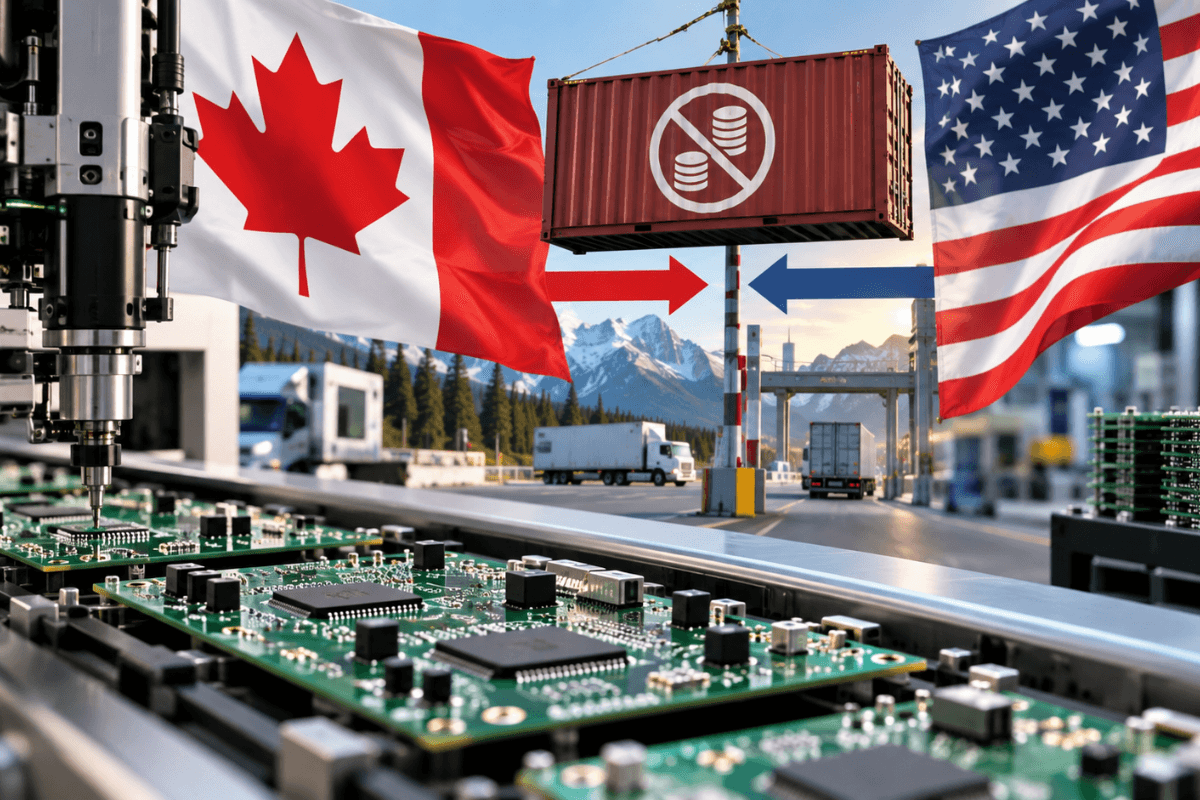
Tariff exposure has moved from a background consideration to a front-page concern for Canadian OEMs. Supply chains built on the assumption of stable trade policy are being re-evaluated, and the cost of that re-evaluation is not small.
The Canadian EMS Landscape
Canada’s electronics manufacturing sector is larger and more established than most buyers realize. The industry supports thousands of establishments and generated $18.6 billion in shipments in 2024, which reflects a sector that is neither niche nor fragile. Labour costs are transparent and moderate by North American standards. Canada also benefits from USMCA / CUSMA market access and regulatory alignment with the United States, which reduces trade friction and compliance overhead for North American buyers.
For programs where proximity to the North American market matters, whether for regulatory reasons, supply chain resilience, or speed of response, Canadian electronic contract manufacturing sits in a strong position.
The Canadian Electronic Contract Manufacturing Advantage
The advantages of domestic manufacturing show up in the line items that are hardest to predict offshore. Lead times measured in days rather than weeks change inventory requirements and cash flow. Direct access to the production floor compresses the feedback loop on quality issues, engineering changes, and new product introductions. If something goes wrong, the conversation happens in real time, during the same business day, with the people who can actually fix it.
For programs with frequent design revisions, high-mix low-volume requirements, or quality standards that leave little room for error, the operational fit of a Canadian electronic contract manufacturing partner is often worth more than the unit cost differential suggests.
There’s also the traceability question. Regulated industries and sophisticated OEMs increasingly require documentation depth that’s faster to access and easier to act on when the supplier is local. Component genealogy, test records, and production data mean more when the facility is close enough to visit.
How the Two Models Compare
Canada is not the lowest sticker-price destination for electronics manufacturing. For programs that value speed, engineering responsiveness, domestic control, and lower disruption risk, it is often the lowest-risk, lowest-friction, and most predictable total-cost option for electronics serving North American markets.
Canadian vs. Offshore Electronics Manufacturing: A Cost Comparison
| Cost Element | Canadian EMS | Offshore EMS |
|---|---|---|
| Assembly labour | Higher unit cost | Lower unit cost |
| Inventory held in transit | Lower | |
| Engineering change speed | Faster | Slower |
| Quality issue resolution | Faster | Slower |
| Total landed cost on fast-moving products | Often competitive | Often eroded by delay cost |
| Regulatory alignment (North America) | Strong | Variable |
| Supply chain disruption risk | Lower | Higher |
EMS Partners: Finding the Right Fit
Volume, design maturity, quality standards, supply chain risk tolerance, and the true cost of downtime all shape the sourcing decision. For programs that demand complexity, responsiveness, and close collaboration, Canadian electronic contract manufacturing tends to be the stronger long-term choice.
Talk to IMS About Your Production Needs
IMS Electronics Manufacturing works with companies across numerous sectors evaluating their sourcing options, from first-time OEMs to established manufacturers re-examining their supply chain. If you’re looking for a Canadian electronic contract manufacturing partner, call 587-816-4300 or fill out our contact form online.