Electronics manufacturing for oil and gas isn’t a standard assembly job with a different label. The products built for this sector, like remote monitoring systems, SCADA controllers, downhole sensors and artificial lift controls, operate in conditions that punish every design shortcut and expose every gap between your PCB and the enclosure it lives in.
Choosing the right Canadian manufacturing partner for these applications takes more than a price comparison.
The Problem with Splitting PCB and Enclosure
Many buyers still source their PCB assembly and their metal enclosure from separate vendors. It’s a common approach, and it creates predictable problems.
When the PCB layout and enclosure mounting aren’t co-designed, small gaps in seams, gasket compression, and cable glands let moisture and dust into the enclosure over time. Flux residues on the board accelerate corrosion by forming conductive paths under humidity. Mounting holes, standoffs, and stiffeners that don’t match the enclosure’s cut-outs create mechanical stress at solder joints during thermal cycling and vibration. These issues lead to cracked vias and intermittent connections in the field.
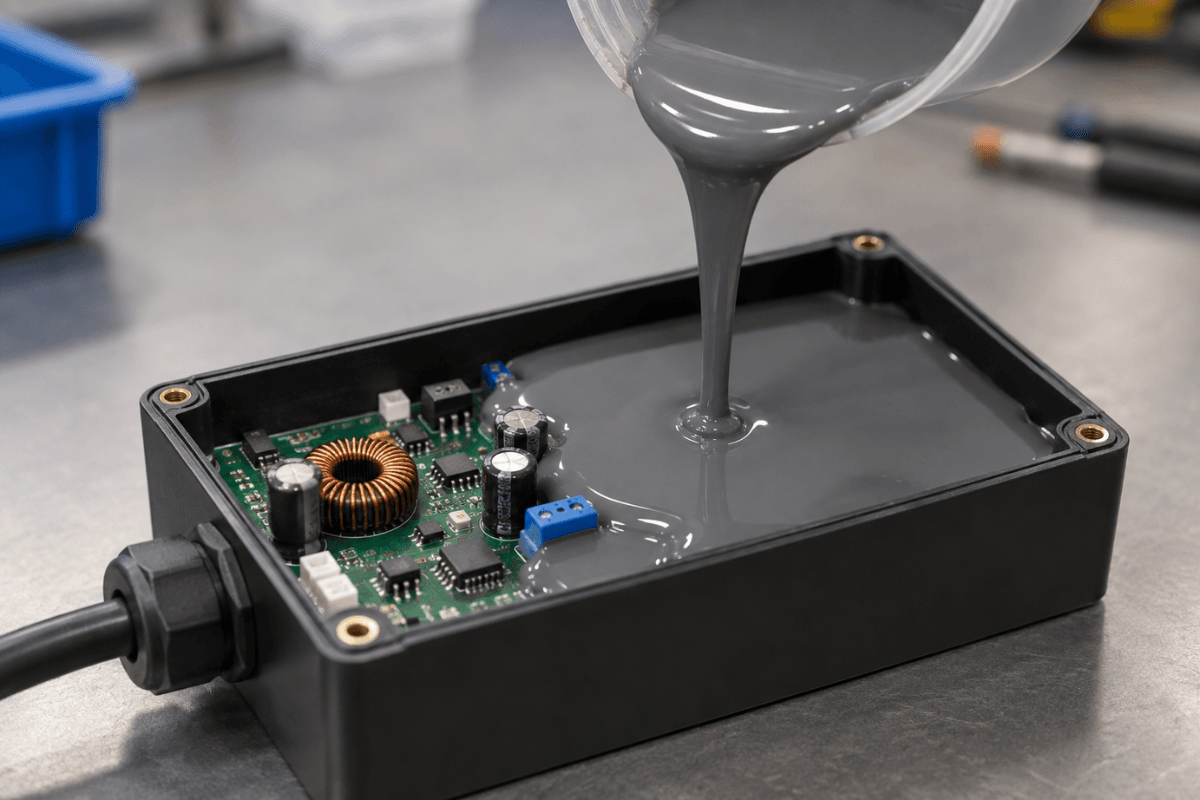
EMI compounds the problem. A well-shielded PCB can still pick up noise if the enclosure has poor gasket contact, unmatched grounding pads, or oversized cable entries. And conformal coating or potting applied without understanding the enclosure’s wash-down, venting, and assembly sequence creates trapped moisture and thin-spot areas that accelerate corrosion. These are defects that rarely show up in bench testing but appear as field returns months later.
With two vendors, each claims “we built to spec.” Reliability gets optimized by trial and error in the field rather than in design.
Why Integration Changes the Outcome in Oil and Gas Manufacturing
When PCB assembly and metal enclosure fabrication happen under one roof, the team designing the board layout, coating process, and depaneling sequence also designs the enclosure’s grounding, seals, and mounting points. Thermal and mechanical co-design becomes possible. Process continuity means root-cause analysis is tractable when a field unit fails. One plant controls the full chain from board laminate through conformal coating to enclosure sealing.
For oil and gas applications specifically, this matters because thermal, mechanical, and environmental stresses are tightly coupled. A manufacturer that handles both disciplines in-house closes the loop between electrical, mechanical, and environmental design – cutting field-failure risks and accelerating time to deployment.
IMS Electronics Manufacturing is one of the few Canadian contract manufacturers where PCB assembly, box build, sheet metal fabrication, and cable harnessing happen in a single facility. For energy OEMs building products that need to perform in the field, that integration directly reduces the risk of field failures.
Questions Worth Asking
The capability questions that separate experienced harsh-environment manufacturers from generalists are specific. Before committing to an EMS partner, ask:
Experience & Track Record
- What percentage of your current production is for oil and gas or similar harsh-environment industrial applications?
- Can you show us examples of products built for remote monitoring, SCADA, or upstream and downstream control systems?
- Can you show us two or three references for similar harsh-environment products and any field-reliability data you track?
Process & Quality
- How do you track defects, perform root-cause analysis, and close corrective actions?
- Can you support thermal management, EMI mitigation, and conformal coating selection for field-deployed equipment?
- How do you co-design the PCB layout, mounting points, and enclosure with the customer?
Supply Chain & Long-Term Support
- How do you manage obsolescence and long-lead components for products with 10 to 15-year field lifetimes?
- Do you offer repair, rework, and long-term spares management for legacy field units?
Electronics Manufacturing for Oil and Gas: The Canadian Advantage
A domestic manufacturer offers faster communication, easier site visits, and more responsive troubleshooting when field failures occur – factors that matter more when your equipment is deployed at a remote well pad or a northern processing facility than when it’s in a controlled industrial environment.
Scalability also matters for energy OEMs. The right partner handles prototype and low-volume pilot runs with the same process discipline as volume production, so the transition doesn’t introduce new failure modes as your program grows.
IMS works with energy sector companies across the globe on electronics that need to perform in demanding field conditions. Call 587-816-4300 or reach out through our contact form to discuss your project.