Keeping counterfeit electronic components out of your products depends heavily on how your PCB assembly partner buys, tracks, and checks parts on your behalf.
You’re reviewing a quote for another run of a board you’ve built for years. The bill of materials hasn’t changed, but one component has been discontinued. Your assembly partner can still source it. Before you approve the quote, ask: Where would these parts come from, what records can you show me for the lot, and could you tell me which boards used it if a problem came up later?
This guide is written for procurement, supply chain, and quality leads at original equipment manufacturers (OEMs) that outsource printed circuit board (PCB) assembly. It’s most useful if you’re qualifying a new manufacturing partner, transferring an existing build, or keeping a mature product in production. We cover what authorized sourcing means, what happens when authorized stock runs out, how IMS manages sourcing and traceability, and the questions we recommend asking before you award your next build.
What authorized sourcing means
For an electronics manufacturing partner buying components for your build, there are three common sourcing routes.
- Original component manufacturer (OCM): Buying directly from the company that makes the part gives you the shortest chain of custody.
- Authorized distributors: These distributors sell parts under an agreement with the component manufacturer. For an authorized sale, they source the parts from that manufacturer or another distributor it has authorized, with documentation that traces the parts back through the authorized channel.
- Independent distributors and brokers: Suppliers who buy and resell parts outside the manufacturer’s authorized channel. They can fill real gaps during shortages, and the quality of what they deliver depends heavily on who they are and how they verify stock.
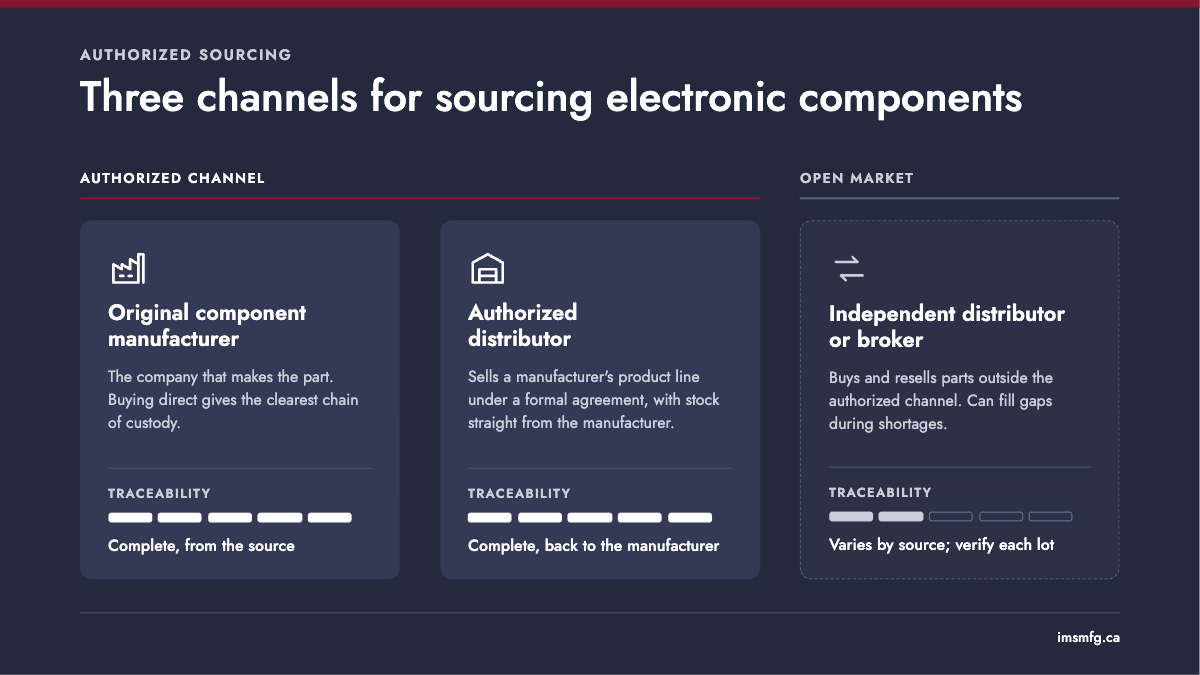
Buying from the manufacturer or an authorized distributor gives a complete chain of custody. Parts from independent sources need verification lot by lot.
When authorized stock runs out
When a part isn’t available through authorized distribution, there are usually three ways forward:
- Adjust the schedule. If the part is delayed rather than unavailable, waiting for authorized stock can be the simplest answer, especially when purchase orders are already in place.
- Qualify an alternate. A form-fit-function replacement from an authorized source keeps the chain of custody clean. Alternates documented on your BOM during design make this much faster.
- Buy from an independent source, if your program allows it. Some programs permit this with the right controls; others, especially in regulated markets, restrict it entirely.
Independent channels carry a higher risk of counterfeit electronic components, so when the third option is on the table, you should be clear on these things before anything is purchased:
- what your manufacturer will tell you about the source.
- who approves the purchase.
- what verification the parts will go through before they’re built in.
IMS works only with brokers it knows and has established terms with. That standard comes from experience. As we’ve shared in our article on component shortages and rising lead times, IMS has seen customers choose an unknown broker against our advice, and the order arrived counterfeit or never arrived at all. A known source with a track record is one of the most effective protections available.
For more on keeping a build moving during a shortage, see what good manufacturing partners do when a parts shortage affects your build.
How IMS keeps counterfeit electronic components out of your build
Protection takes several layers of control, each covering a different point in a part’s path from purchase to finished board.
- Authorized distributors first; known brokers only when needed. IMS maintains relationships with multiple authorized distributors, which widens the pool of traceable stock before any other channel is considered.
- Barcode traceability from arrival to assembly. IMS’s integrated barcode system tracks parts from the moment they arrive through to assembly, with procurement and inventory managed in Intuitive ERP.
- Board-level material traceability. IMS records components at receipt and tracks them to the individual boards they’re built into.
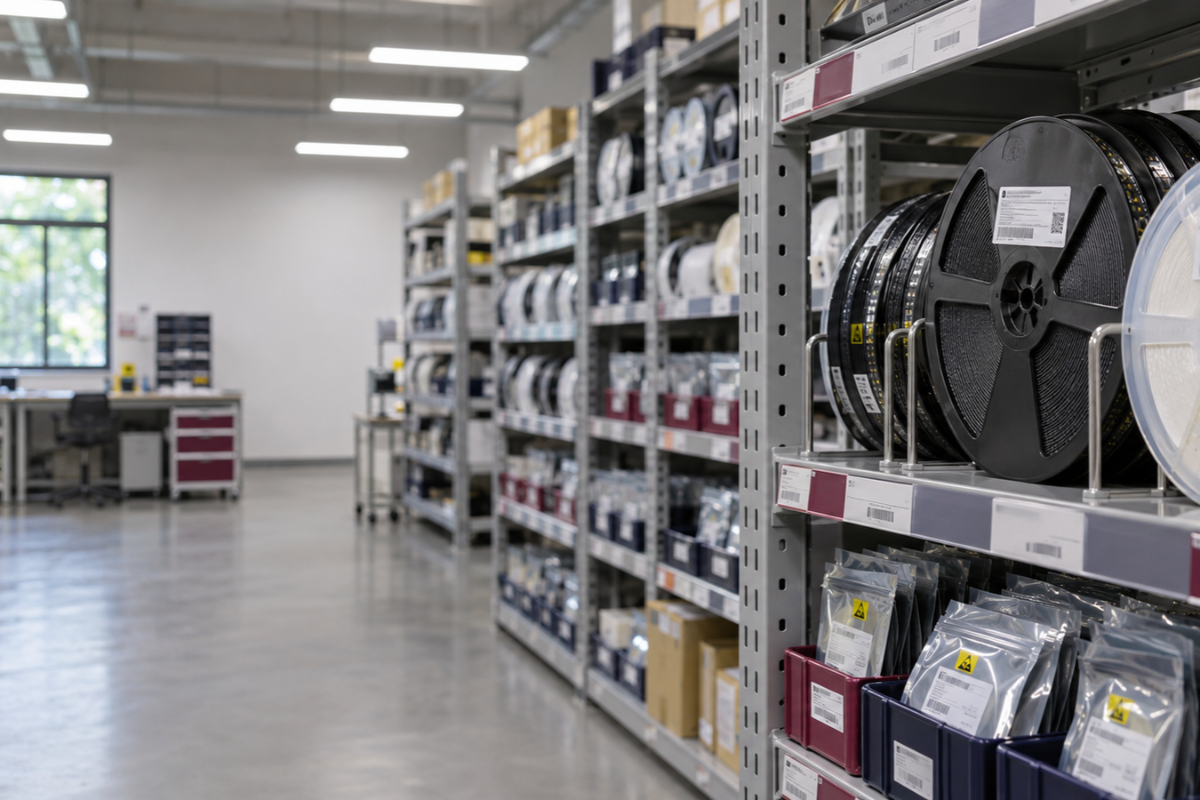
- Controlled storage. Moisture-sensitive surface-mount parts are stored in a Fortress ISM 2000S storage system, and critical parts are kept in climate-controlled conditions, so genuine parts stay in the condition they arrived in.
- Accurate counts. An X-ray parts counter verifies the quantity on each reel, keeping inventory records matched to what’s physically on the shelf.
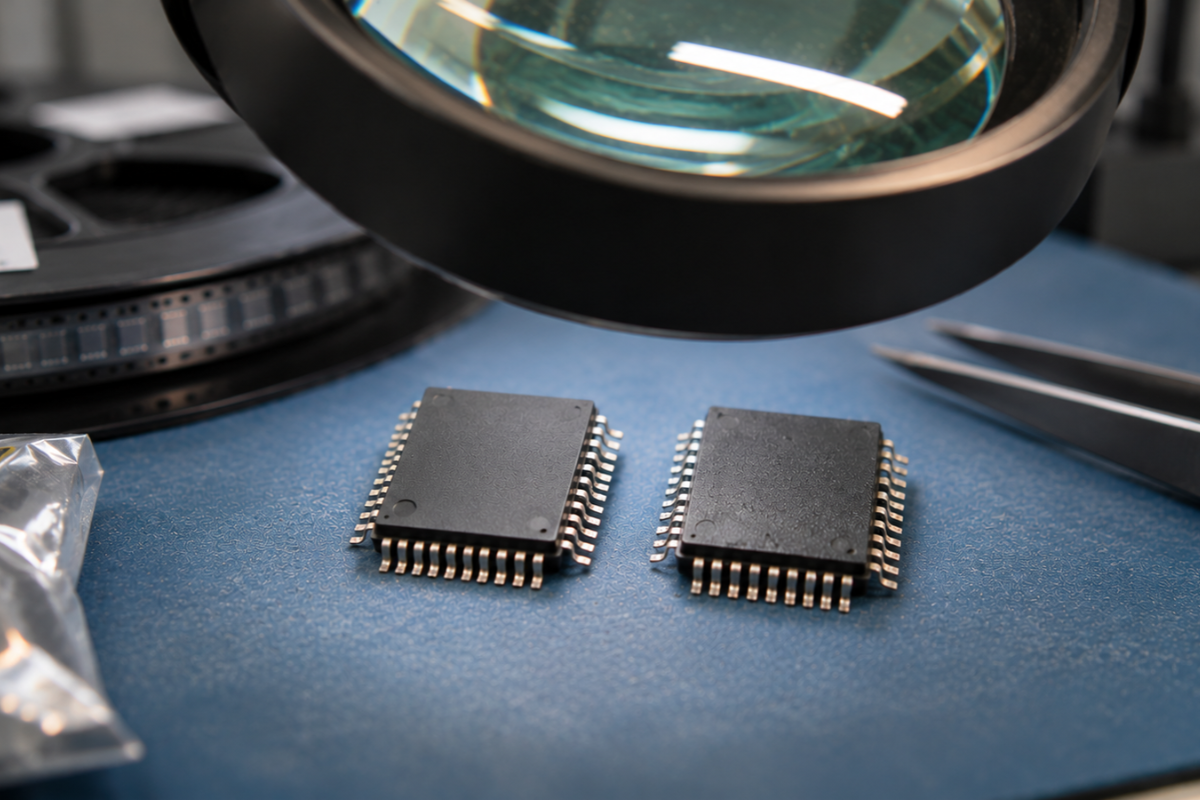
- Inspection of finished assemblies. A Glenbrook Technology JewelBox X-ray system inspects hidden solder joints, including ball grid arrays (BGAs) and other leadless devices, as part of IMS’s quality checks.
Quality checks start at receiving. IMS inspects incoming material so issues are caught before components are built into your boards, and when a part has to come from outside authorized distribution, it comes only from a broker IMS knows and has an established record with.
Traceability and authentication do different jobs. Barcodes and board-level records show where a part came from and where it went. Verification at receipt is what confirms a part is genuine. Together, they give you a clear record if a question ever comes up later.
Tracing parts after the boards ship
Traceability answers two separate questions, and it helps to ask your manufacturer about both:
Can you show where a component lot came from?
The source, purchase records, and documentation for that specific lot.
Can you show which assemblies received it?
If a lot is ever questioned, this is what tells you which units are affected, instead of every unit built during that period.
IMS’s traceability reaches the individual board level. If a lot is ever questioned, the record shows exactly which boards received it.
Example: A client building wireless communications hardware for commercial aircraft needed every component traced to where and when it was procured. IMS set up the receiving and tracking process that gave the client that record. Read the aerospace PCB assembly case study.
The level of traceability a program needs varies. Aerospace and defence builds often require it to the board, while other programs may need lot-level records. Agreeing on the level up front makes sure the records you’ll need exist from the first build.
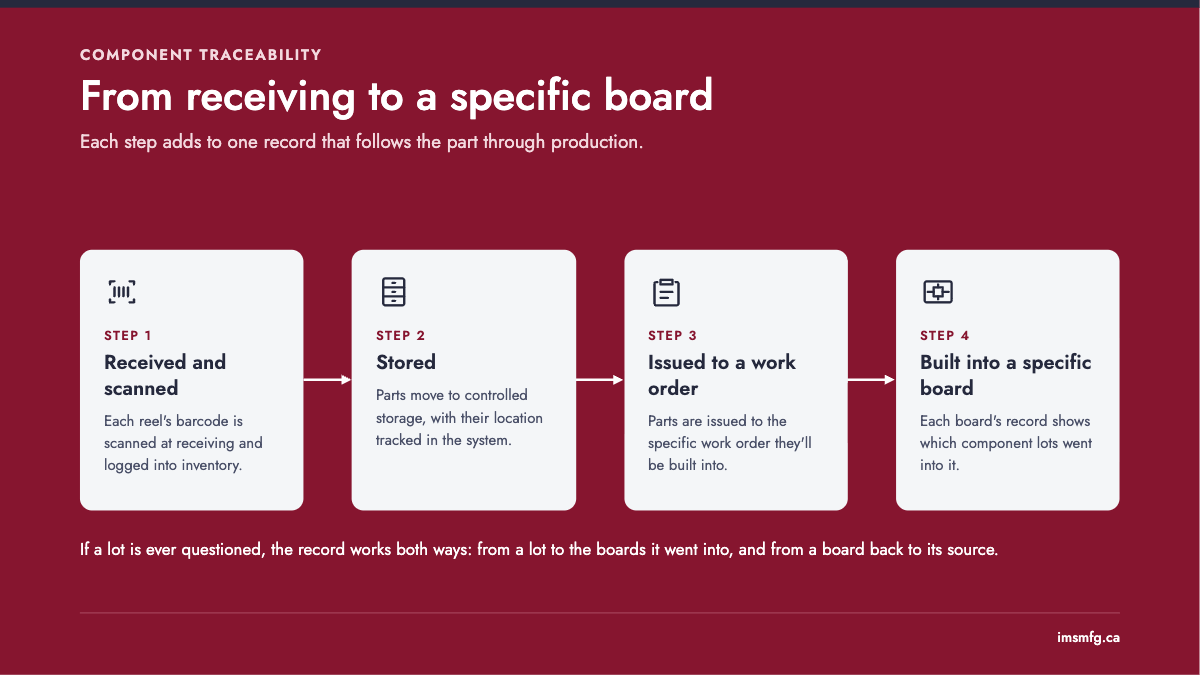
Each step adds to a single record, so any board can be traced back to its component lots, and any lot forward to the boards it went into.
Four questions to ask before awarding your build
Whether you’re qualifying a new partner or reviewing a current one, these questions show how a manufacturer protects your build from counterfeit electronic components:
Which sources are approved for my program?
Confirm whether independent distributors are allowed at all, and under what conditions.
Will you tell us before buying outside authorized channels?
A clear notification and approval step keeps you in control of what goes into your product.
What documentation can you provide for a specific lot?
Ask what a typical lot record includes, such as certificates of conformance and purchase history.
If a lot is questioned later, can you identify the affected builds?
The answer shows how far the manufacturer’s traceability actually reaches.
When you ask about approved sources, keep in mind that authorization applies to a specific manufacturer’s product line rather than to a distributor as a whole. A large, familiar distributor may be authorized for one manufacturer’s parts and not another’s. A traceable lot is what counts, and it’s the most reliable protection against counterfeit electronic components.
If your program references industry standards, three commonly come up. SAE AS6496 addresses authorized distribution, SAE AS6081 sets requirements for independent distributors, and SAE AS5553 guides counterfeit-parts prevention for organizations that buy and build with electronic components. They’re useful reference points when you discuss sourcing requirements with a manufacturer.
Include your sourcing and traceability requirements in your request for quote (RFQ), so every quote you compare reflects them. Our guide to preparing an electronics manufacturing RFQ covers what to include.
Talk through sourcing and traceability with IMS
Knowing exactly how your manufacturer sources and tracks parts gives you confidence in every board that ships. If you’d like to discuss the sourcing and traceability requirements for your next PCB build, call IMS today, or reach out through our contact form.