An industrial control panel can stay in service for 20 years. A medical device may stay in production for a decade after launch. Many of the components inside those products have much shorter production runs. Electronic component obsolescence management is the planning that closes that gap, so a long-lifecycle product stays buildable, serviceable, and supported for as long as your customers rely on it.
Component turnover is a steady, ongoing part of the industry. Lifecycle data firm Z2Data tracked nearly 474,000 electronic components reaching end-of-life in 2023, and around 30% of them were discontinued without a product change notice. The pace picked up in 2025. Component obsolescence and silent discontinuations are expected to continue as major supply chain pressures persist heading into 2027.
For OEMs in industrial automation, energy, medical devices, transportation, test and measurement, agriculture and heavy equipment, and defence, that pace makes obsolescence a planning task from the first schematic onward. Most of the risk can be managed with clear decisions made at the right time.
This guide follows a product through its life, from design to field support, and covers what to plan for at each stage. If you’d like a primer first, our article on planning ahead for component obsolescence covers the fundamentals.
Building electronic component obsolescence management into your design
Every component has its own electronic component lifecycle: introduction, growth, maturity, decline, and end-of-life. Where a part sits on that curve when you select it shapes how long you can build with it.
A few design habits give a long-lifecycle product a strong start:
- Check lifecycle status before you commit. A part that’s already marked “not recommended for new designs” (NRND) or approaching decline is a short-term choice for a long-term product.
- Favour parts early in their lifecycle. A component in its growth or early maturity phase typically has years of production ahead of it.
- Choose multi-sourced parts and industry-standard packages where you can. Parts with several qualified manufacturers and common footprints give you options later.
- Flag single-source parts early. Some will be unavoidable. Listing them up front lets you agree on a plan for each one before production starts.
- Design layouts that can accept an alternate. Footprints that fit more than one package, or board space reserved for a likely substitute, can turn a future redesign into a simple component swap.
These checks are especially valuable in regulated markets. In medical devices, a component change can trigger re-validation, so selecting parts with long production horizons up front can save significant work years later.
It also helps to bring your EMS partner into the design review. A contract manufacturer’s purchasing team sees lead times, pricing shifts, and allocation patterns across many builds, and that view can flag a risky part before it’s locked into your BOM.
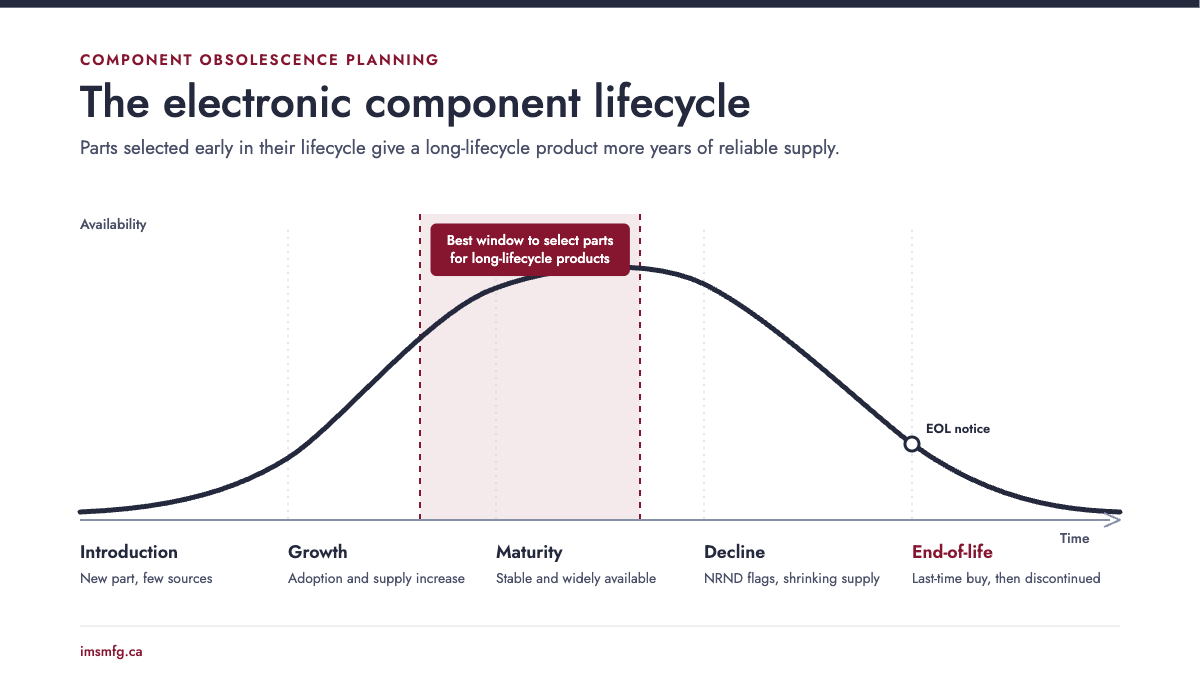
Selecting parts during late growth or early maturity gives a long-lifecycle product the most years of supply ahead.
Keeping your BOM healthy during production
Once a product is in steady production, electronic component lifecycle management becomes a routine check-in rather than a one-time task. The goal is to see changes coming early enough that you can choose your response.
A practical routine includes:
- Scheduled BOM health reviews. Review the lifecycle status of every part on a regular cadence, such as annually or ahead of each major build.
- Tracking notices as they arrive. Product change notices (PCNs), end-of-life notices, and NRND flags are your formal early warnings. Make sure it’s clear who receives them and who decides what happens next.
- Watching for informal signals. Some lifecycle changes arrive without a formal notice. Keep an eye out for warning signs like longer lead times or sudden price changes. They often come before an end-of-life announcement.
- Keeping your approved alternates current. An alternate qualified five years ago may have its own lifecycle concerns today.
Let’s look at an industrial automation OEM building a motor controller that’s been in production for eight years. A yearly BOM review flags a voltage regulator moving into decline. Because the team sees it early, they have time to qualify an alternate and introduce it at a planned revision, with no disruption to deliveries.
Your manufacturer can support this routine. Every quote and purchase order gives a contract manufacturer a current read on availability, so agreeing up front on how and when they share component changes with you keeps everyone working from the same information.
Our article on planning for component shortages covers more on reading these supply signals.
Your options when a component reaches end-of-life
When an end-of-life notice arrives, managing electronic component obsolescence comes down to choosing the right response for that part and that product. Most situations fall into one of four options.
| Option | When it fits | What to plan for |
|---|---|---|
| Use an approved alternate | An alternate is already qualified on your BOM | Confirm the alternate’s own lifecycle status |
| Qualify a form-fit-function replacement | A drop-in part with the same footprint and performance exists | Testing and documentation updates; re-validation in regulated products |
| Make a last-time buy | No suitable replacement exists, or the product is late in its life | Quantity, storage, shelf life, and carrying cost |
| Plan a partial redesign | The part has no replacement and the product has years of life left | Engineering time, requalification, and a revision rollout |
Whichever option you choose, buy replacement stock through authorized distributors wherever possible. Parts sourced from the open market need extra inspection and verification before they go into a build.
Sizing a Last-Time Buy
A last-time buy works best when the quantity is based on the product’s full remaining life.
Consider:
- Remaining production volume: expected annual builds multiplied by the years of production left.
- Service and spares demand: repair builds and replacement boards for units already in the field.
- Allowance for yield and attrition: a reasonable buffer for normal manufacturing losses.
- Storage and shelf life: moisture-sensitive parts need controlled storage, and solderability can degrade over long periods.
- Carrying cost: the cash tied up in inventory, weighed against the cost of a redesign.
An energy OEM supporting field monitoring units, for example, might size a last-time buy to cover five more years of production plus a decade of spare boards for installed sites. Agreeing with your manufacturer on who stores that stock, and under what conditions, is part of the plan.
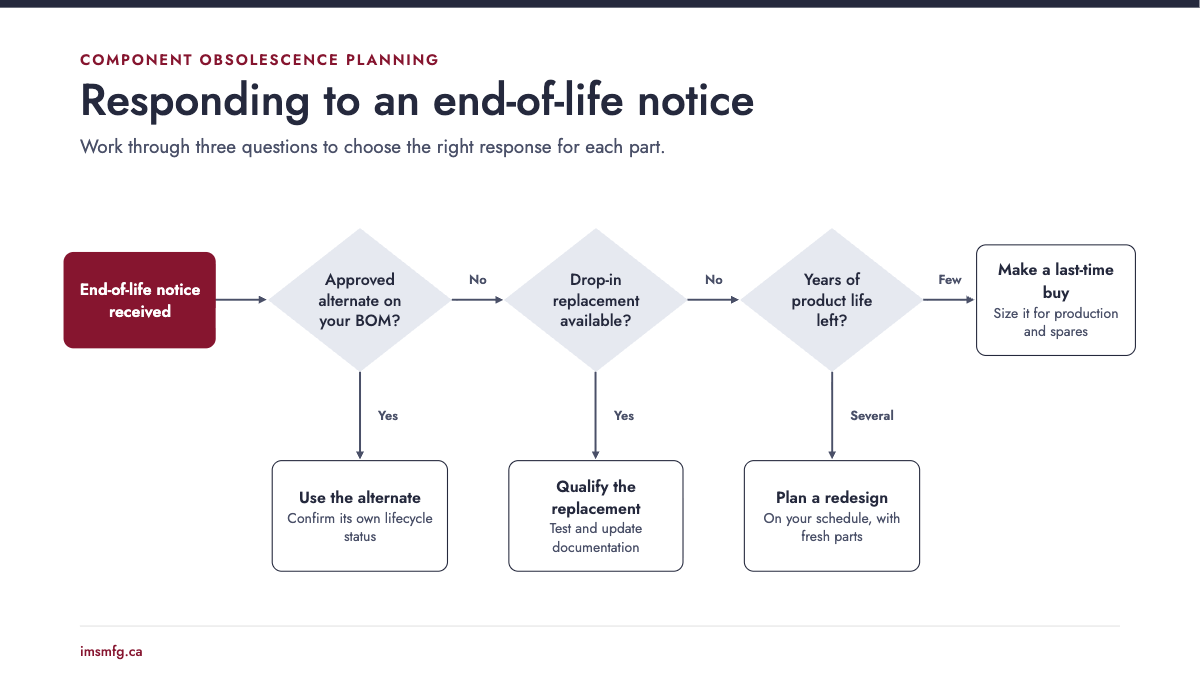
Three questions help OEMs choose the right response when a component reaches end-of-life.
Knowing when a redesign is the better path
Alternates and last-time buys can keep a product in production for years. At some point, a planned redesign often becomes the more practical choice. Z2Data puts the cost of an obsolescence-driven redesign anywhere from about US$20,000 to nearly US$2 million, which is why planning the timing yourself pays off.
Signals that a redesign may be worth scheduling:
- Several components on the same board are in decline or already end-of-life.
- Last-time-buy inventory is growing, along with the cost of storing it.
- Each new alternate needs its own testing and requalification.
- The product would benefit from updates anyway, such as improved efficiency, new features, or easier assembly.
A test and measurement OEM, for example, might bundle three at-risk components into one board revision and add a newer communications interface at the same time. One planned revision replaces several separate workarounds, and customers get an improved product.
The advantage of watching for these signals is choice. A redesign scheduled a year or two ahead can be engineered, tested, and introduced on your timeline. Involving your manufacturer during that redesign also gives you a chance to apply design for manufacturability (DFM) improvements and select parts with fresh lifecycles, which resets the clock for the next stretch of production.
Supporting long-lifecycle products in the field
For many OEMs, the product’s life continues well after the last production run. Customers in transportation, energy, agriculture, and industrial markets often expect repairs and replacement parts for as long as the equipment is in service.
Planning for field support means keeping the ability to build and test older revisions:
- Revision-controlled documentation. BOMs, drawings, assembly instructions, and test procedures for every revision still in the field.
- Maintained test fixtures and programs. Fixtures for older boards stay calibrated and ready, along with the firmware and test software that go with them.
- A clear record of what’s installed where. Knowing which revisions your customers are running makes spares planning far more accurate.
- Spares built into the lifecycle plan. Service demand belongs in every last-time-buy calculation and redesign decision.
A rail equipment OEM, for example, may need to supply replacement control boards for onboard systems a decade after the final production build. With current documentation and working test fixtures, a small repair build is a routine order. The same applies to agriculture and heavy equipment, where control units in tractors, combines, and construction machinery are often repaired and replaced over a long working life.
Serviceability decisions made at the design stage help here too. Enclosures and cable assemblies designed for easy access make field repairs faster, which we cover in our guides to serviceable enclosure design and cable assembly for service-minded OEMs.
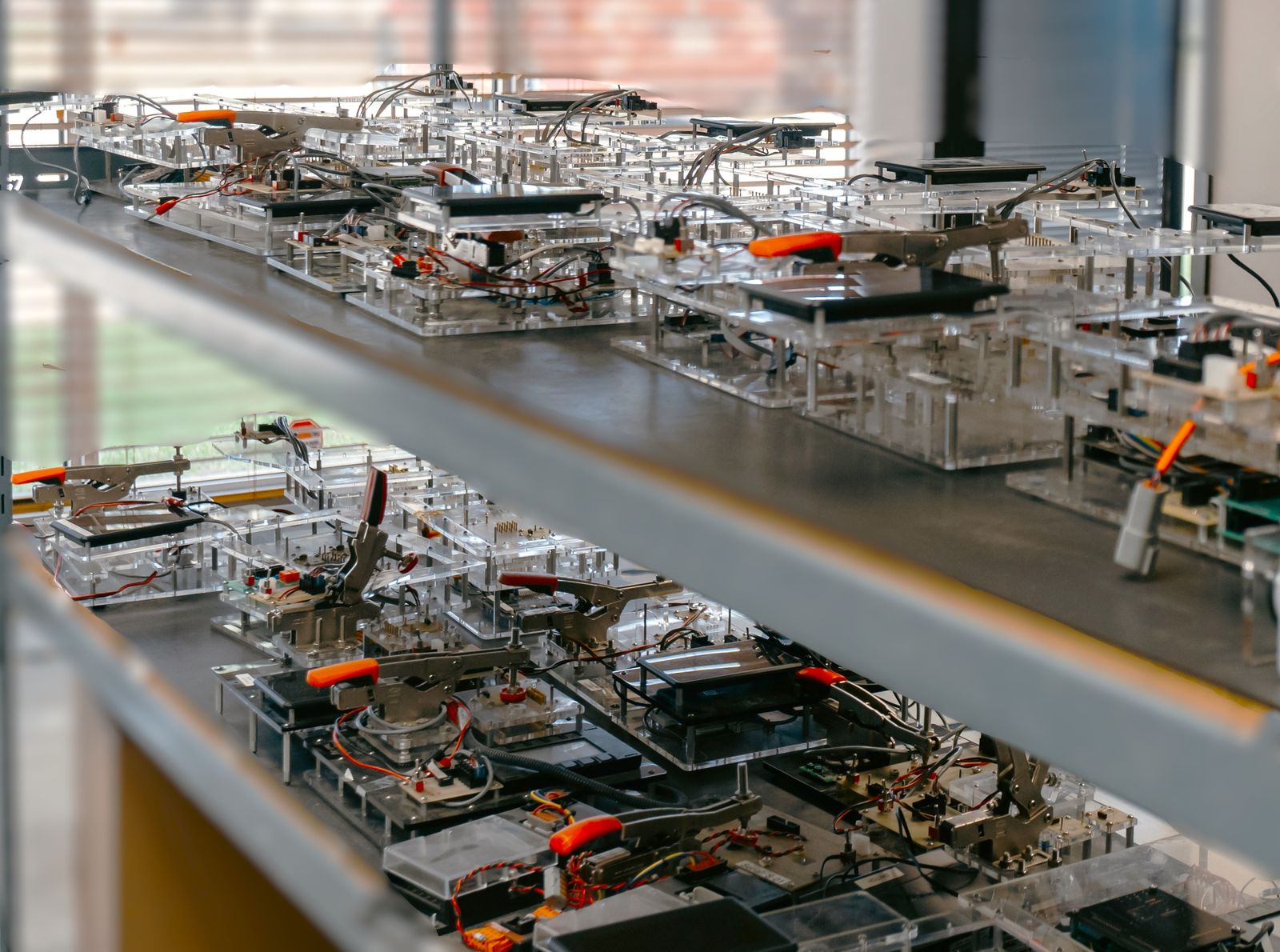
Functional test fixtures at IMS Electronics in Calgary. Maintained fixtures and test programs, allowing older product revisions to be built and tested for years after the last production run.
What to look for in a long-term manufacturing partner
A 20-year product benefits from a manufacturer who can support it for the same span.
When you’re evaluating partners for a long-lifecycle program, look for:
- Continuity of records and people. Revision history, build records, and the team members who know your product’s background.
- Proactive communication. A clear process for sharing PCNs, end-of-life notices, and supply signals as soon as they appear.
- Engineering support. Help qualifying alternates, sizing last-time buys, and planning redesigns.
- Strong distributor relationships. Authorized sourcing channels and the purchasing experience to work through allocation.
- Capability across the whole product. When the same manufacturer builds your circuit boards, cable assemblies, sheet metal, machined parts, and final box build, a component change in one assembly can be managed alongside its effects on the others.
IMS has seen how much long relationships can accomplish. One of our customers in military training systems has worked with us for more than 20 years, through many component changes and product revisions. You can read more about that program in our military training systems case study. The same planning discipline supports industrial, energy, medical, and other programs where products are expected to last.
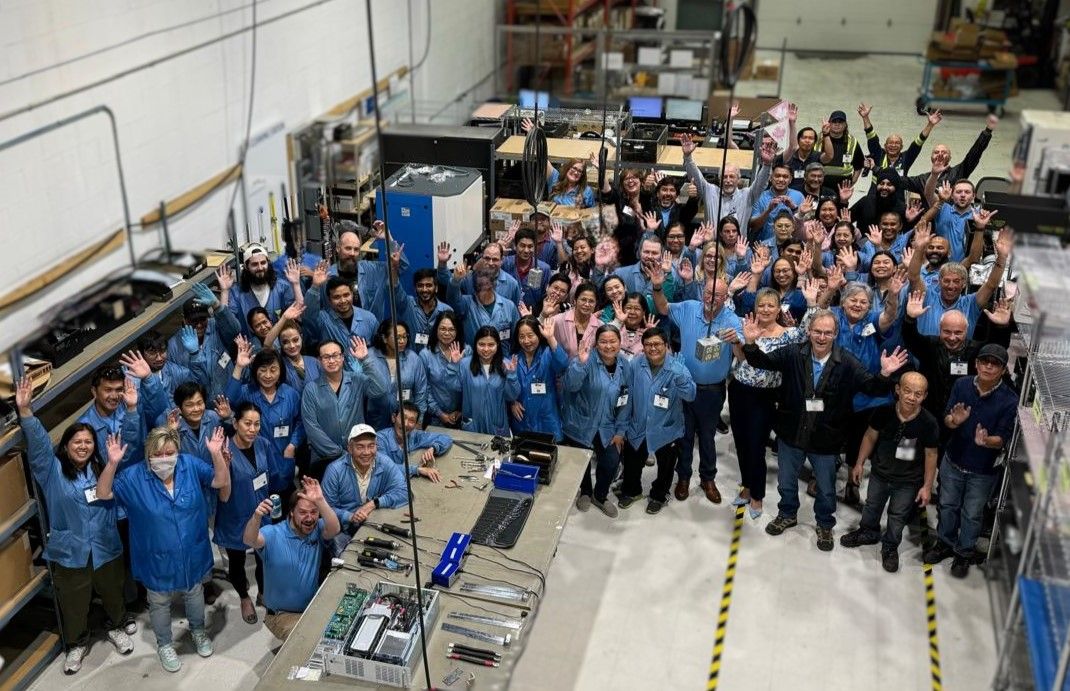
The IMS team on the production floor at our electronics manufacturing facility in Calgary, Alberta.
Plan for the long run with IMS Electronics
Electronic component obsolescence management works best as a steady, shared process between you and your manufacturer. With the right planning at each stage, a long-lifecycle product can stay in production and in service for as long as your customers need it.
If you have a product line that needs to stay in production for years to come, we’d be glad to talk through its BOM and lifecycle plan with you. Call IMS today, or reach out through our contact form.