

Canada is changing how it buys military equipment, and the change reaches deep into the supply chain. On February 17, 2026, the federal government launched its first Defence Industrial Strategy, titled “Security, Sovereignty and Prosperity.” Its message to industry is simple: build in Canada wherever possible.
On October 6, 2026, the government introduced Bill C-40, which would turn the Defence Investment Agency into a Crown corporation with more authority to procure, invest and produce.
Most coverage focuses on submarines, aircraft and armoured vehicles. But every one of those platforms runs on circuit boards, cable assemblies and enclosures, and many of those parts are still built offshore. This article explains what the strategy says, what has happened since it launched, and what OEMs and prime contractors should be doing about their electronics supply chains now.
Key Takeaways
- The Defence Industrial Strategy (DIS) aims to direct 70% of defence acquisitions to Canadian firms within 10 years.
Under its “Build–Partner–Buy” framework, new procurements in sovereign capability areas will typically go to Canadian firms as a matter of policy. - Bill C-40 would make the Defence Investment Agency a Crown corporation with its own board and dedicated minister.
- Canadian content earns preference at bid evaluation, and Industrial and Technological Benefits (ITB) reforms are set to reward direct work with Canadian suppliers.
- For OEMs, offshore electronics manufacturing is becoming a competitive risk, not just a supply chain risk.
What Is Canada’s Defence Industrial Strategy?
The Defence Industrial Strategy is a 10-year plan to grow Canada’s defence industry by steering more federal defence spending to Canadian companies. It’s backed by $6.6 billion of the $81.8 billion defence reinvestment in Budget 2025, according to the strategy document. It supports Canada’s NATO commitment to spend 5% of GDP on defence and security by 2035.
The strategy sets clear 10-year targets:
- 70% of defence acquisitions awarded to Canadian firms
- An 85% increase in defence research and development
- A 240% increase in defence industry revenues
- $5.1 billion more per year in defence revenue for small and medium-sized businesses (SMBs)
- A 50% increase in defence exports
- 125,000 new jobs
The strategy is organized around five pillars:
- Renewing the relationship with industry, including a long-term demand signal and faster security clearances
- Procuring strategically through the Defence Investment Agency and the Build–Partner–Buy framework
- Investing in innovation, SMBs, exports and the workforce
- Securing supply chains, including critical minerals, steel and aluminum
- Working with domestic partners and investing in the North and Arctic
The strategy also notes that SMBs make up 92% of Canada’s roughly 600 defence firms. That is why so many of its measures target smaller suppliers, not just the primes.
Build, Partner, Buy: How Canada Will Choose Suppliers
The heart of the strategy is a three-step decision framework, summarized in a briefing to the House Standing Committee on National Defence: “We will build at home whenever possible, partner with foreign suppliers where it makes sense, and buy from abroad when necessary.”
- Build: In areas of Canadian strength and key sovereign capabilities, new defence procurements “will typically be directed to Canadian firms as a matter of policy,” according to the strategy.
- Partner: Where Canada lacks the capability, it will work with trusted allies to deliver it jointly.
- Buy: When neither is possible, Canada will buy from allies, with conditions that require reinvestment in Canada and keep sovereign control over operation and sustainment.
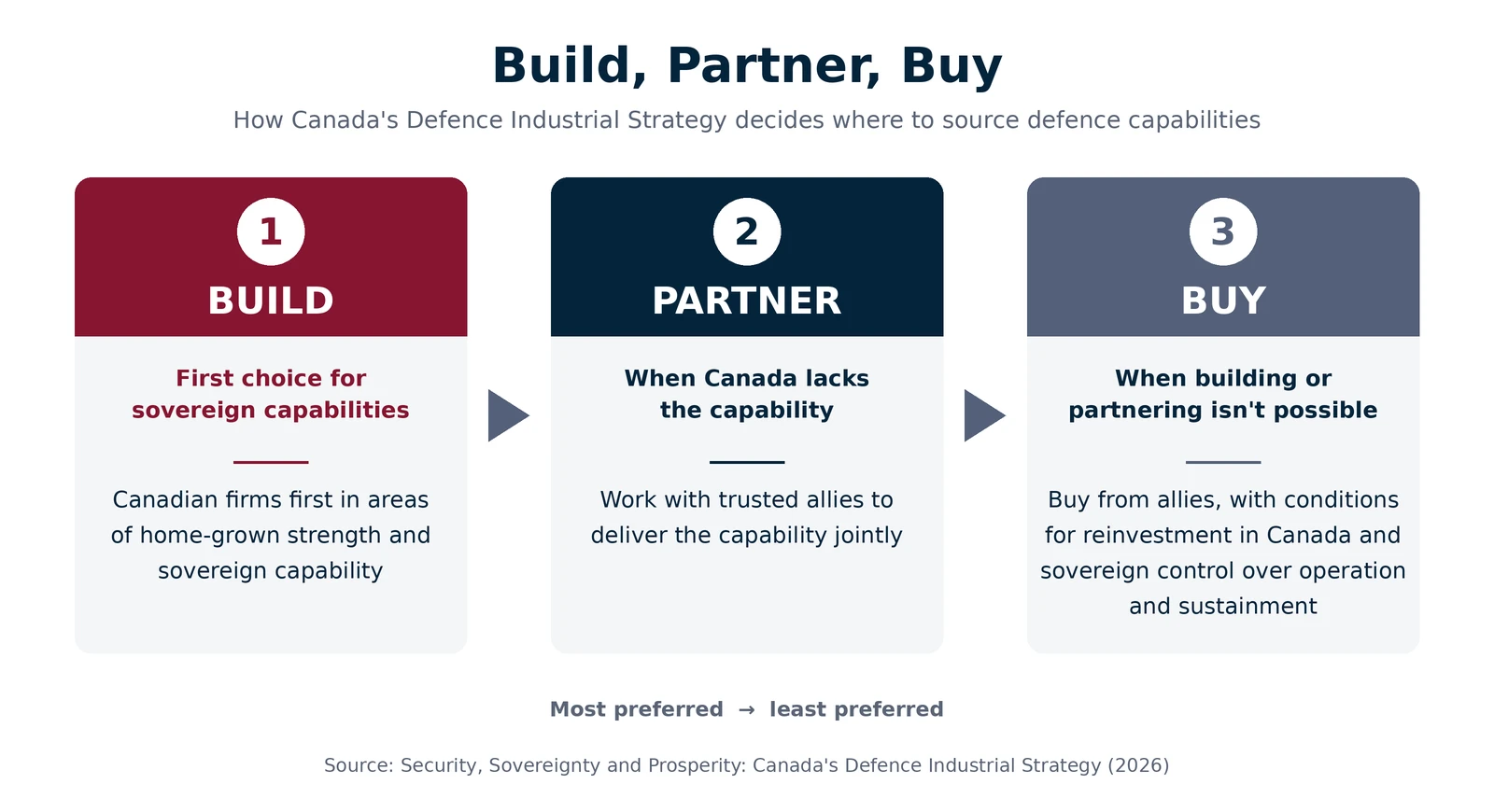
Canada’s Build–Partner–Buy framework. Source: Defence Industrial Strategy, 2026.
The 10 Sovereign Capabilities
The strategy names 10 sovereign capabilities where Canada intends to build at home. Nearly all of them depend on electronics:
| Sovereign capability | Where electronics come in |
|---|---|
| Aerospace | Avionics and aircraft communications |
| Ammunition | Fuzing and guidance electronics |
| Digital systems | Command, control and communications (C3) and high-assurance communications equipment |
| In-service support | Repair, overhaul and replacement assemblies |
| Personnel protection | Wearable and soldier systems |
| Sensors | Marine, quantum and electronic warfare sensors |
| Space | Satellite and ground station hardware |
| Specialized manufacturing | Land vehicle and surface ship systems |
| Training and simulation | Simulators and training systems |
| Uncrewed and autonomous systems | Flight controllers, payloads and ground control |
Source: Sovereign capabilities are from Canada’s Defence Industrial Strategy. Electronics examples are illustrative.
What Has Changed Since February 2026
The strategy is moving quickly from plan to practice.
Bill C-40 and the Defence Investment Agency (DIA)
The Defence Investment Agency (DIA) was created in October 2025 to speed up defence procurement. Bill C-40, introduced October 6, 2026, would establish it as a Crown corporation, legally named the Canadian Corporation for Defence Investment, according to the government backgrounder. It would have its own board of directors and report to a new Associate Minister of National Defence for Procurement. As of late October 2026, the bill is at second reading in the House of Commons, so these changes are not yet law.
The government says a Crown corporation can negotiate and manage contracts “using commercial practices that are more familiar to industry,” with less administrative burden for suppliers. Skies Magazine reports that the agency is preparing to manage a core defence spending increase that the Parliamentary Budget Office says could reach $163 billion by 2035.
Canadian Content Is Now Part of the Contract
Recent awards show what “build in Canada” looks like in practice. Colt Canada’s new rifle contract includes a commitment to at least 80% Canadian content. A new partnership with General Dynamics Land Systems-Canada for 190 more armoured combat support vehicles draws on more than 600 Canadian suppliers in over 100 communities.
The federal Buy Canadian Policy adds another layer. It gives preference at bid evaluation to Canadian suppliers and to bids offering Canadian content. It first applied to strategic procurements over $25 million, and the government planned to lower that threshold to $5 million by spring 2026.
ITB Reforms Favour Direct Work With Canadian Suppliers
The Industrial and Technological Benefits (ITB) Policy requires contractors on major defence procurements to generate business activity in Canada equal to the value of their contracts. The strategy proposes reforms that include a “Canadian Company Boost,” which would reward primes for direct work with Canadian firms, especially SMBs. For foreign primes in particular, a Canadian electronics supplier becomes a practical way to meet obligations.
New Programs for Drones and Regional Suppliers
The Defence Drone Initiative launched on July 23, 2026, as a standing marketplace to qualify Canadian suppliers of uncrewed systems and components, according to Quwa. The marketplace reopens every three months through mid-2027.
Regional funding is flowing too. The $379.2 million Regional Defence Investment Initiative helps businesses join defence supply chains, and it is delivered in the Prairies by PrairiesCan. Recent Alberta recipients include companies expanding military-grade cable and wiring production and defence electronics manufacturing (PrairiesCan).
What the Strategy Means for OEMs’ Electronics Supply Chains
For OEMs and primes, the policy translates into four practical shifts.
1. Where Your Electronics Are Built Now Affects Your Bid
When Canadian content earns preference at bid evaluation and proposed ITB reforms reward direct Canadian work, a circuit board assembled offshore is more than a cost line. It can weaken a bid. Electronics can be a significant share of a system’s value, so moving PCB assembly, cable harnesses and box build to Canada can make a real difference to a Canadian-content figure.
2. Traceability and Documentation Matter More
Sovereign control means knowing where every assembly came from and who built it. Expect more questions about material traceability, workmanship standards and supplier records. For mission-critical electronics, that usually means IPC Class 3 builds with full lot traceability.
3. Security Requirements Reach the Supplier Level
Any organization that examines, possesses or transfers controlled goods or technology in Canada must register in the Controlled Goods Program, and that includes receiving bid documents that contain controlled goods. The strategy commits to faster security clearances and facility accreditation, but the requirements still apply. OEMs should confirm early which parts of a program involve controlled goods and plan their supplier needs around that.
4. Capacity Will Get Tighter
The strategy projects $180 billion in defence procurement by 2035. As spending rises, so will demand for qualified Canadian manufacturing capacity, components and skilled labour. OEMs that qualify Canadian suppliers early will be in a better position than those that wait for a contract award. Our posts on reshoring electronics manufacturing and electronic component shortages cover the planning side.

Building the full assembly in Canada, from circuit boards to enclosures, simplifies Canadian-content reporting.
What OEMs Should Do Now
- Map your electronics bill of materials by origin. Identify which assemblies are built offshore and what share of system value they represent.
- Identify sovereign capability overlap. If your product falls under one of the 10 sovereign capabilities, assume Canadian content will be weighed.
- Qualify Canadian suppliers before you bid. First articles, quality audits and documentation reviews take time. Starting after award is too late.
- Prepare for ITB and Canadian-content reporting. Ask suppliers what records they can provide to support your reporting.
- Check controlled goods requirements. Confirm which parts of the program involve controlled goods and what that means for each supplier.
- Watch for opportunities. Follow CanadaBuys, the Defence Investment Agency’s industry days and the Defence Drone Initiative marketplace. Prairie companies can also look into PrairiesCan’s defence programs.
For a deeper look at what to ask a manufacturer, see our guide to electronics manufacturing for Canadian defence contractors.
How IMS Supports Canadian Defence Supply Chains
IMS Electronics Manufacturing is a Canadian-owned contract manufacturer in Calgary. For more than 20 years, we have supported a global military training systems manufacturer. What began as circuit board assembly has grown to include precision sheet metal fabrication. We also manufacture electronic hardware for aircraft communications systems.
Our ISO 9001:2015-certified facility brings PCB assembly, cable and wire harness assembly, sheet metal fabrication, CNC machining, conformal coating and potting, box build and testing under one roof. That means fewer hand-offs and one Canadian supplier accountable for the full assembly. For primes with ITB obligations, we can provide supplier documentation, Canadian-content information and project records that may help support your reporting.
Learn more about our military and defence electronics manufacturing.
Frequently Asked Questions
What is Canada’s Defence Industrial Strategy?
It is the federal government’s first plan to grow the domestic defence industry, launched February 17, 2026. It aims to direct 70% of defence acquisitions to Canadian firms, grow defence industry revenues by 240% and create 125,000 jobs within 10 years.
What does Build–Partner–Buy mean?
It is the strategy’s procurement framework. Canada will build at home in areas of Canadian strength and sovereign capability, partner with trusted allies where it lacks the capability, and buy from abroad only when necessary, with conditions that require reinvestment in Canada.
What is the Defence Investment Agency?
The Defence Investment Agency was created in October 2025 to speed up defence procurement and use it to build Canadian industry. Bill C-40, introduced October 6, 2026, would make it a Crown corporation with its own board and a dedicated associate minister. As of late October 2026, the bill is at second reading in the House of Commons.
Does the strategy affect suppliers, or only prime contractors?
It affects both. Canadian-content preferences and the proposed ITB reforms give primes reasons to source more components and assemblies from Canadian suppliers, especially SMBs.
What is the ITB Policy?
The Industrial and Technological Benefits Policy requires contractors on eligible major defence and Canadian Coast Guard procurements to generate business activity in Canada equal to the value of their contracts. Work placed with Canadian suppliers can count toward those commitments.
It’s Time to Build Your Defence Electronics in Canada
If you’re reviewing where your electronics are built, IMS can help you assess what can move to Canada and how to get it production-ready. Contact our team today to request a quote.