Surface Mount Technology is the default assembly process for most modern electronics, and for good reason. It’s fast, precise, and built for compact, high-density boards. But when a design is headed into a mining vehicle, an oil field, or a piece of rail equipment instead of a climate-controlled office, that default deserves a second look.
For a rugged application, does Surface Mount Technology hold up on its own, does the design need Through Hole Technology instead, or does it call for both? Getting this right early shapes how reliable the finished product will be over years of field use, and it’s a question worth working through before a manufacturing partner is locked in.
One quick clarification before going further: SMD (Surface Mount Device) refers to the component itself. Things like resistors, capacitors, and integrated circuits designed to sit directly on the surface of a board. SMT and THT are the two manufacturing processes used to attach components to a printed circuit board. SMD isn’t a competing process to SMT or THT; it’s simply the type of component that Surface Mount Technology places.
What Is Surface Mount Technology (SMT)?
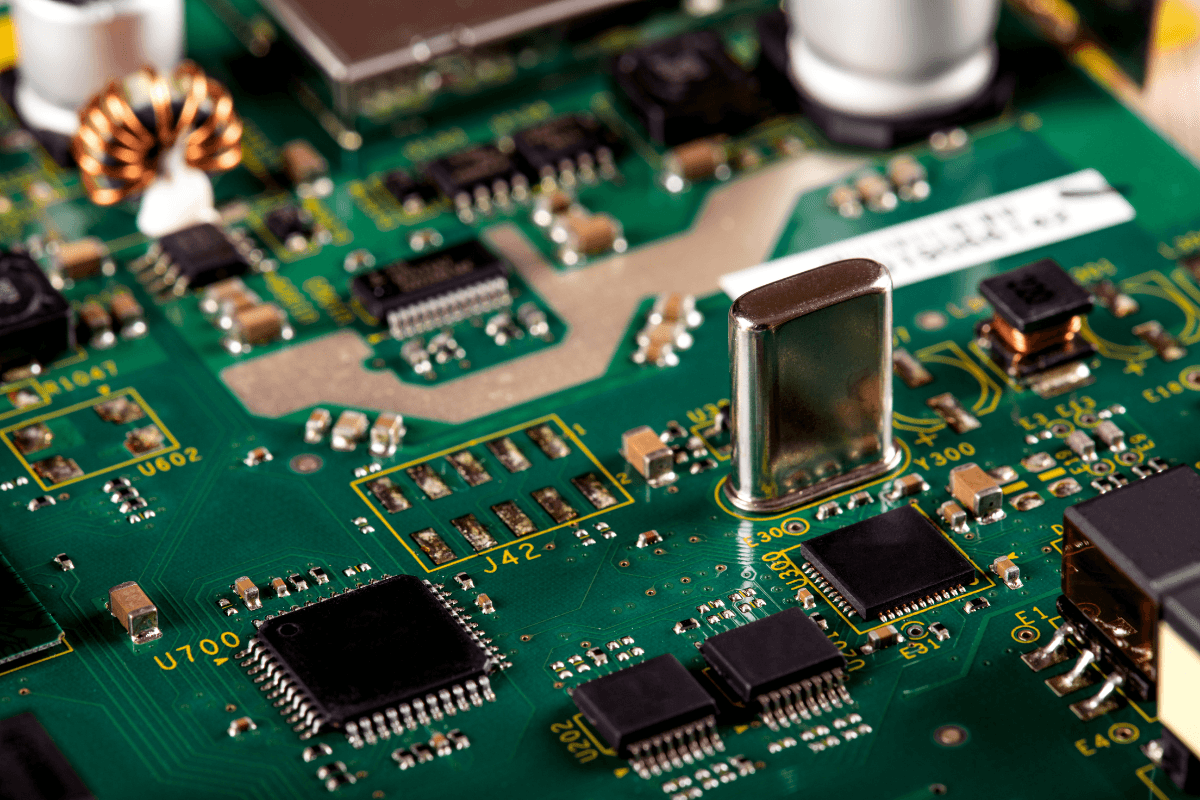
Surface Mount Technology is the process of placing components directly onto the surface of a circuit board and soldering them in place, without drilling through the board itself. It’s the industry standard for a reason. SMT supports smaller components, tighter spacing, and much faster assembly than older methods.
At a high level, SMT assembly follows a consistent sequence. Solder paste is applied to the board, components are placed with automated equipment, the board passes through a reflow oven to set the solder joints, and the finished assembly goes through inspection to catch defects before it ships.
The advantages of Surface Mount Technology:
- Smaller footprint. Surface-mount components allow for denser, more compact board layouts.
- Faster, more consistent production. Automated placement and soldering reduce manual labour and the variability that comes with it.
- Better electrical performance. Shorter connection paths mean less signal interference and better thermal behaviour in many designs.
For high-volume, compact electronics, SMT is very often the right call. But it isn’t the only tool in the box.
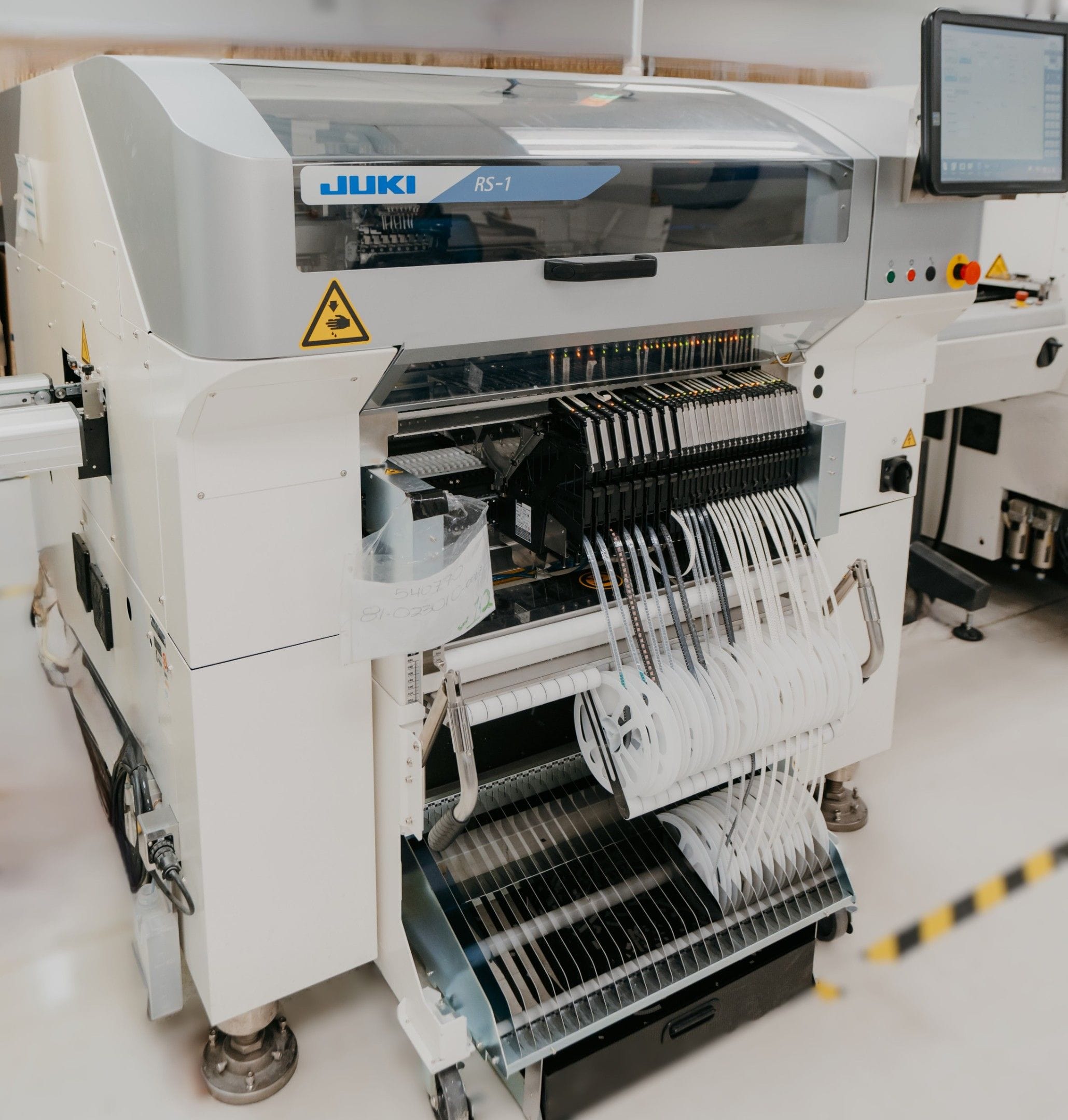
The Juki RS-1 is a high speed SMT pick and place machine used in PCB assembly to accurately position thousands of electronic components per hour. Its precision and flexibility make it a key part of modern Surface Mount Technology (SMT) production lines.
What Is Through-Hole Technology (THT)?
Through Hole Technology takes a different approach. Component leads pass through drilled holes in the board and are soldered on the opposite side, either by hand or through wave soldering. It’s a slower, more manual process than SMT, and it takes up more board space. However, through-board connection creates a mechanically stronger joint.
THT components are physically anchored through the board, not just soldered to its surface, which makes them more resistant to the kind of stress that surface-mount joints don’t handle as well: vibration, repeated thermal cycling, and physical shock. THT also remains the better fit for high-power components, like large capacitors and transformers, that need a solid connection to manage heat and current.
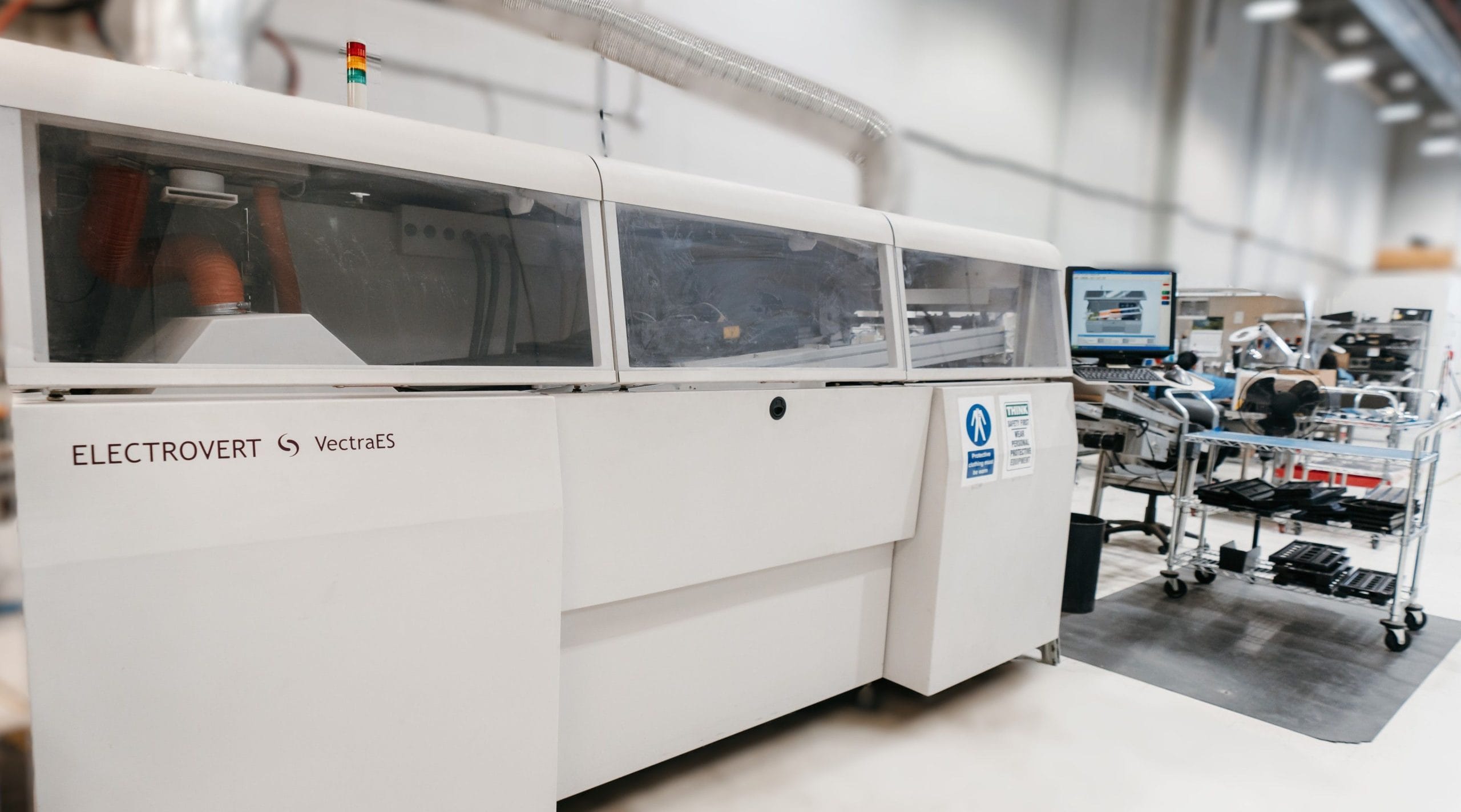
The Electrovert VectraES is a lead free wave soldering machine designed for Through Hole Technology (THT) PCB assembly. Engineered to handle the higher temperatures and unique requirements of lead free solder alloys, it delivers reliable, high quality solder joints for electronic components.
SMT vs. THT for Rugged Applications and Harsh Environments
In a controlled environment, Surface Mount Technology wins by nearly every measure. But rugged applications and harsh environments test a board differently, and that changes which process we recommend.
Surface-mount assemblies are excellent at what they’re built for, but that same compact, surface-level connection is more vulnerable in harsh conditions. Constant vibration, wide temperature swings, mechanical shock, and years of continuous duty put real stress on a board, and in those conditions, the mechanical strength of a through-hole joint is essential.
This is exactly the kind of tradeoff that comes up constantly in industries like:
- Oil and gas, where equipment runs in extreme temperatures and constant vibration
- Mining and heavy equipment, where shock and dust are part of daily operation
- Defence-adjacent and industrial control systems, where a field failure isn’t an option
- Rail and transportation electronics, built for years of continuous duty
If your product is headed into any of these environments, the SMT vs. THT question is one of the first decisions that shapes how reliable your build will be over its working life.
Can You Use SMT and THT on the Same Build?
Yes, and for a lot of rugged and industrial products, that’s exactly the right answer. Combining both processes on a single board is usually called mixed-technology assembly or hybrid PCB assembly. It’s an excellent approach whenever a design has both high-density components and parts that need a stronger mechanical connection.
In practice, this typically means running surface-mount placement and reflow soldering first, since that process handles the bulk of the smaller, high-density components efficiently. Through-hole components, connectors, power components, and anything that needs to withstand vibration or handle higher current are added afterward, usually through wave soldering, selective soldering, or hand soldering depending on the board’s layout and production volume.
Done well, mixed-technology assembly isn’t a compromise between two processes. It’s a way to get the density and speed of surface-mount technology exactly where it helps most, while reserving through-hole’s mechanical strength for the components that actually need it. For most rugged, real-world products, this combined approach is ideal.
How IMS Approaches SMT, THT, and Mixed-Technology PCB Assembly
IMS builds using both surface mount and through-hole processes, and combines the two within a single assembly whenever that’s what the application calls for. That decision gets made early, based on where a component sits, what it has to withstand, and how the finished product will be used, not on which process happens to be faster or cheaper to run. Boards destined for harsh or high-vibration environments get the same attention we bring to our conformal coating and potting work and our broader approach to PCB assembly for extreme conditions.
Choosing the Right Process for Your Build
If you’re weighing this decision for your own product, a few questions can point you in the right direction:
- Will this board see repeated vibration, shock, or temperature swings? If yes, through-hole connections deserve a serious look for at least the components under the most stress.
- Are size and weight the top priority in a controlled environment? Surface mount is very likely the better fit.
- Does the design include high-power components, like large capacitors or transformers? Through-hole often handles the mechanical and thermal load better.
- Is this a one-off prototype or something that may need field repair? Through-hole components are generally easier to remove and replace by hand.
For a lot of real-world products, especially in industrial and rugged applications, the answer is often a mix of both. The goal isn’t to pick a side. It’s to match the process to the field conditions the board has to survive.
Talk to IMS About Your Build
Choosing between SMT and THT, or figuring out where a mixed-technology approach makes sense, is exactly the kind of conversation worth having early, before a design is locked in. IMS builds boards that hold up in rugged environments like oil and gas, mining, and military. Reach out and we’ll walk through what that looks like for your specific application.