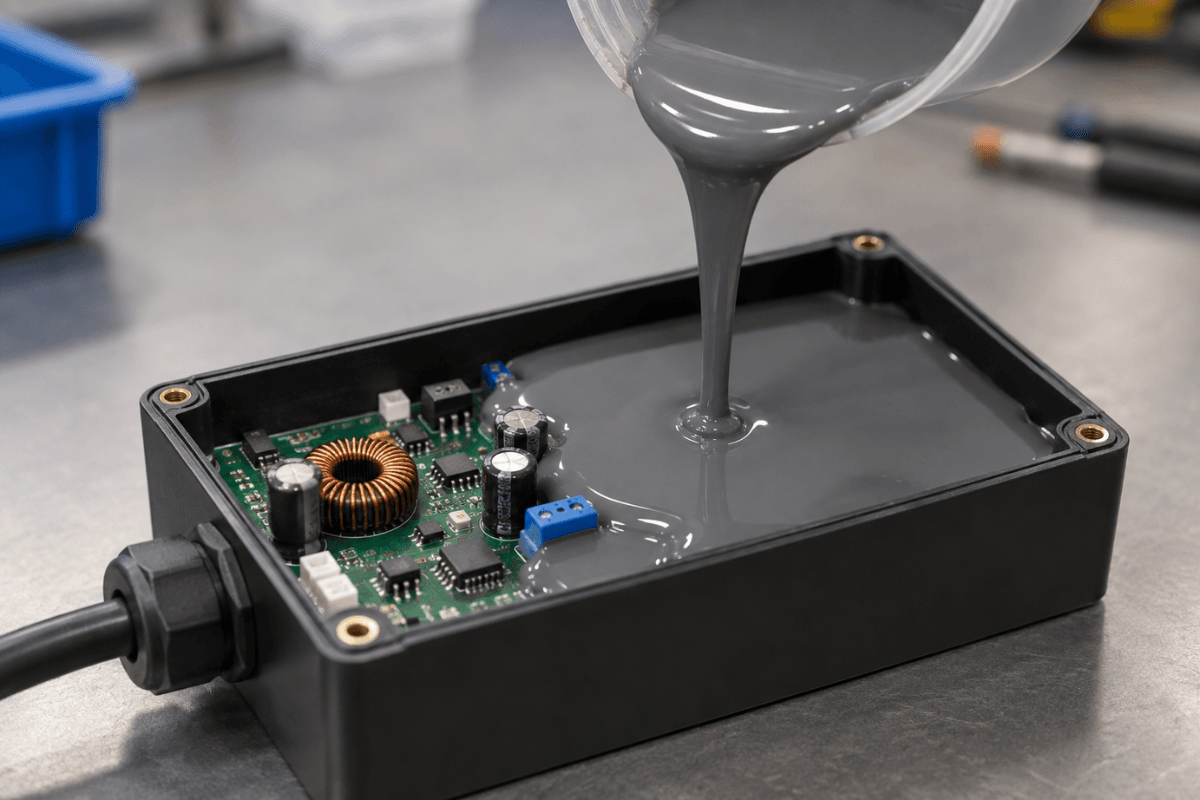
Electronics potting helps OEMs shield important assemblies from moisture, vibration, contaminants, electrical discharge, and tough environments. But protection alone does not make a product ready for production. When a potted assembly moves from prototype to repeat manufacturing, OEM teams also need to plan for testing, heat management, enclosure design, quality checks, traceability, and long-term service needs.
For many products, potting plays a key role in making electronics more durable. It helps protect sensitive electronics found in industrial controls, transportation, oil and gas equipment, monitoring devices, medical equipment, and other uses where electronics face humidity, shock, chemicals, temperature changes, or mechanical stress. The best results come when potting is planned as part of the overall design and manufacturing process, not just at the end.
At IMS, we work with OEMs to combine PCB assembly, coating and encapsulation, cable assembly, mechanical integration, programming, testing, and box-build services. This integrated approach makes sure protection covers the whole product.
Electronics Potting Is a Production Decision, Not Just a Protection Step
A prototype shows that a concept works, but it doesn’t guarantee that the assembly can be potted the same way every time, tested easily, or made reliably in large numbers.
When building a prototype, the team can make manual changes, spend extra time fixing issues, or depend on one technician’s experience. In production, a more controlled process is needed. This means having clear instructions, approved materials, set amounts for dispensing, curing steps, inspection standards, test order, and traceability procedures.
For OEMs, the real question is not just, “Can this unit be potted?” but, “Can we pot this unit the same way every time while meeting quality, delivery, cost, and long-term reliability goals?”
A good production plan covers the whole assembly process, from getting parts and building the PCB to programming, testing, potting, curing, final checks, packaging, and shipping. This is especially important for products used in places with extreme heat or cold, vibration, moisture, chemicals, electromagnetic interference, or pressure changes.
Why Prototype Success Does Not Guarantee Production Success
A potted prototype might work well in early tests, but problems can show up during full-scale manufacturing. Small differences that seem minor in a one-off build can become significant when producing larger quantities.
For example, changes in fill level, enclosure space, material temperature, mixing, cure time, or where parts are placed can affect the final assembly. These differences can impact heat performance, mechanical stress, electrical insulation, appearance, or how easy it is to inspect the product.
Production-ready potting requires OEMs and their electronics manufacturing services partner to define:
- What environmental and functional conditions the product must withstand
- Which areas of the assembly must be fully protected
- Which connectors, switches, LEDs, fasteners, labels, or interfaces must remain accessible
- How much potting material each unit requires
- How air is allowed to escape during the fill process
- What testing must be completed before the assembly is sealed
- Which visual and functional criteria determine whether a unit passes inspection
- What records must be retained for traceability and quality investigations
The goal is not to make things more complicated, but to find out what is needed early so the enclosure, PCB, test tools, instructions, and production steps can support those needs.
Define What a Successful Assembly Must Prove
Before production begins, OEM teams should decide what a good potted assembly looks like and how it must perform. Just saying “fully potted” is not enough as a standard.
Depending on the application, production requirements may include:
- Functional performance after potting and cure
- Defined fill height, fill weight, or coverage area
- Acceptable limits for voids, bubbles, cracks, overflow, or exposed components
- Electrical insulation requirements
- Adhesion and material-compatibility requirements
- Cosmetic requirements for visible assemblies
- Thermal performance under realistic operating conditions
- Resistance to moisture, chemical exposure, vibration, shock, or temperature cycling
- Serial number, lot, and material-batch traceability
The clearer an OEM is about these requirements, the easier it is for an EMS partner to write useful work instructions and inspection steps.
This is especially important for rugged or mission-critical uses. Electronics used in aerospace, oil and gas, factories, defence, or demanding field conditions must keep working even with vibration, humidity, corrosive materials, extreme temperatures, and other environmental stressors.
Electronics Potting Must Support Your Test Strategy
Before introducing electronics potting, OEMs should determine exactly which activities must occur while the circuit board and its components remain accessible.
Common pre-potting steps include:
- Programming firmware
- Functional testing
- Calibration
- Visual inspection
- Serial-number assignment
- Traceability data capture
- Electrical verification
- Customer-specific quality checks
After the potting material has cured, it can be hard or impossible to reach components, solder joints, test points, and connectors. If a problem is found later, the unit may be tough to diagnose, repair, or rework.
Having a clear test plan before potting helps avoid the costly mistake of sealing a unit before it’s fully checked. It also gives OEMs better information for finding the cause if a problem happens in the field.
For example, an industrial monitoring device might need firmware programming, sensor calibration, functional checks, and a serial number recorded before potting. If the product fails a final test after potting, the OEM and manufacturer need to know if the problem started with a part, assembly, programming, calibration, or the potting itself. Good records before potting make it easier to investigate.
IMS offers programming and functional testing as part of its mechanical assembly and box-build capabilities, allowing OEMs to incorporate these requirements into a coordinated production workflow.
Design the Enclosure for Consistent Potting
Potting results depend on more than just the material used. The enclosure and mechanical design also affect how well the material can be applied and whether the finished product works as needed.
OEMs should consider the following early in the design process:
- Fill-port location and accessibility
- Venting paths that allow trapped air to escape
- Clearance around components and connectors
- Defined keep-out zones for parts that must remain exposed
- Mounting features that hold the PCB securely during dispensing and cure
- Fill-depth requirements
- Areas that require masking or protection
- Access for test fixtures before potting
- Space for thermal interfaces, heat sinks, or enclosure contact points
A well-designed enclosure helps make the potting process more consistent and lowers the chances of trapped air, incomplete filling, overflow, or uneven coverage.
This is another area where a manufacturing partner can help. Mechanical assembly, cable routing, connector placement, enclosure features, and PCB layout should all work together. IMS offers full box builds, mechanical assembly, rapid prototyping, and protective coating and encapsulation services, helping OEMs look at the whole product instead of treating each step separately.
Treat Thermal Performance as a Finished-System Requirement
Electronics potting should be considered as part of the entire thermal system, not just as a final protective layer added after the PCB is designed.
Some assemblies produce a lot of heat. Power devices, regulators, processors, LEDs, relays, and other components may need a clear path for heat to leave the board. In those cases, the potting material, PCB design, enclosure, thermal interface, heat sink, and the surrounding operating environment all affect how well the product works.
OEM teams should consider:
- Which components generate the most heat
- The maximum expected operating temperature
- Whether heat must transfer through the potting material
- Whether the enclosure provides a useful heat-dissipation path
- How fill depth and material coverage affect thermal performance
- Whether voids or air pockets could compromise heat transfer
- How the finished, potted assembly performs under realistic load conditions
It’s important to test thermal performance on the finished, potted unit, not just on an unpotted board. Electronics in tough environments may face high temperatures and temperature changes, which can stress PCB materials, solder joints, and components if the system is not built for these conditions.
Build Process Control Into the Production Plan
In repeat manufacturing, electronics potting is only as reliable as the process used to apply it. A controlled production workflow helps reduce variation between units and keeps quality steady over time.
A manufacturing plan should define:
| Production control | Why it matters |
|---|---|
| Approved potting material | Ensures the product is built using the intended compound and properties |
| Material storage requirements | Helps protect shelf life and material performance |
| Mix ratio and mixing procedure | Supports reliable cure and consistent finished properties |
| Pot life | Helps teams manage usable working time, scheduling, and material waste |
| Dispensing method | Improves repeatability in coverage, volume, and fill level |
| Cure conditions | Supports consistent curing and predictable production flow |
| Inspection criteria | Creates clear pass/fail standards for finished assemblies |
| Traceability records | Helps support investigations, corrective action, and change control |
Process documentation is especially helpful when the OEM needs to increase production, update the product, approve new parts, or investigate a field failure. If a specific material batch, production lot, or design change is connected to a quality concern, traceability records help the OEM and EMS partner find out how big the problem is and respond properly.
IMS uses coating and encapsulation methods with silicone, urethane, and epoxy materials, along with cable, mechanical, and full box-build services. Choosing the right solution should look at both environmental protection and the manufacturing process and product lifecycle needs.
Plan for Rework, Repairs, and Warranty Support
Potting is a good option when you need environmental protection, tamper resistance, electrical insulation, or mechanical stability. However, OEMs should carefully weigh the tradeoff between durability and how easy it is to service the product.
Before approving a production potting process, consider:
- Can a failed unit be diagnosed after potting?
- Is selective depoting possible or practical?
- Can individual modules be replaced instead of repairing the entire assembly?
- Will failures be repaired, replaced, or scrapped?
- Does the expected warranty model support a non-serviceable product?
- Are spare units or field-replacement modules required?
- What product and process records will be available for failure analysis?
In some cases, making an assembly hard to access is the right choice. In others, using a modular design, selective potting, conformal coating, or another protection method may better support long-term service needs.
The best choice depends on the product’s environment, expected lifespan, service plan, risk of failure, and total cost. A low-volume, specialized industrial unit might need stronger, permanent protection, while a product meant for field service may need a different balance between protection and access.
Move From Protection Requirements to Production Readiness
Potting works best when it is planned early, before the enclosure, test steps, thermal design, and service plan are set. OEM teams that involve their EMS partner early can spot manufacturing risks before they turn into production delays, quality problems, or extra costs.
Before releasing a potted product to production, ensure your team has addressed:
- Environmental and reliability requirements
- Potting material and approved alternatives
- Test, programming, calibration, and inspection requirements
- Enclosure fill, venting, access, and masking details
- Thermal-performance requirements
- Curing and throughput expectations
- Acceptance criteria and quality documentation
- Rework, repair, warranty, and replacement strategy
- Traceability and engineering-change requirements
Partner With IMS for Production-Ready Electronics Potting
Electronics potting works best when protection needs, PCB assembly, enclosure, testing, thermal design, and production steps are all planned together.
IMS helps OEMs with integrated electronics manufacturing services like PCB assembly, cable assemblies, mechanical assembly, coating and encapsulation, programming and testing, full box builds, protective packaging, and delivery support. Our coating and encapsulation use silicone, urethane, and epoxy to help electronics handle tough conditions.
If you are taking a potted electronics assembly from prototype to production, reach out to IMS to talk about your environmental needs, test process, enclosure design, and manufacturing goals. A well-planned potting process can protect your product and support steady quality, scalable production, and reliable field performance.