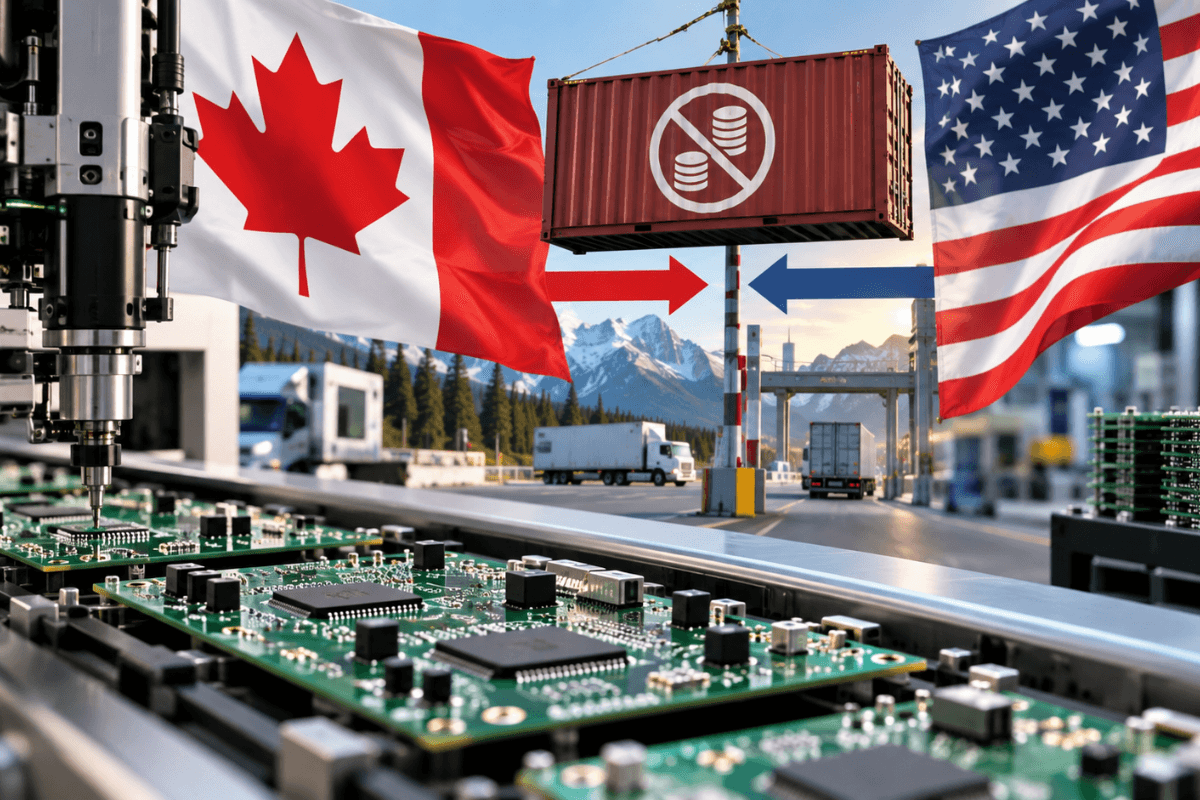
The impact of tariffs on Canadian manufacturing now goes beyond waiting to see what happens with CUSMA.
On August 22, 2026, the United States began applying an additional 50% tariff under Section 338 of the Tariff Act of 1930 to certain Canadian imports. The original measures covered 554 HTSUS classifications, including 166 classifications in Chapter 85, which covers electrical machinery, equipment, and related parts.
That matters to electronics companies. Even if a business has no connection to the automotive, dairy, or alcohol sectors behind the trade disputes, products such as motors, transformers, batteries, telecommunications equipment, monitors, LED modules, signalling equipment, and some electronic assemblies may be affected, depending on their HTSUS classification.
For Canadian OEMs, this is a useful reminder that tariff planning should focus on the exact products you make and ship, not only on general trade-agreement news.
Important note: The original Section 338 measures have already changed. The U.S. modified certain product lists effective September 15, 2026, and further measures affecting specified Canadian motor-vehicle, dairy, and alcoholic-beverage products are scheduled to take effect September 29. Always confirm the current treatment of a specific product before shipping.
The Impact of Tariffs on Canadian Manufacturing: A Different Kind of Risk
Much of the recent discussion about Canada–U.S. trade has focused on the CUSMA review and the possibility that North American trade rules could change.
That is still important. However, Section 338 creates a different type of risk.
Section 338 is part of the U.S. Tariff Act of 1930. It allows the President to impose additional duties of up to 50% when the President determines that another country is discriminating against, or treating U.S. commerce unequally compared with, other countries.
The 2026 measures are legally unusual. Trade-law analysis describes them as the first known time a U.S. president has used Section 338 to impose tariffs. There is no established body of court precedent interpreting this type of action, which means the longer-term legal status of the measures could change through further government action or litigation.
For exporters, the key point is practical: a product that qualifies for preferential treatment under CUSMA or USMCA is not automatically exempt from a Section 338 duty if its HTSUS classification is covered.
In other words, exporters need to ask more than one question.
Instead of only asking, “Does our product qualify under CUSMA?” businesses should also ask, “Does our product’s current HTSUS classification appear on a Section 338 tariff list?”
The questions are related, but they are not the same.
Why Electronics Companies Should Pay Attention
The original Section 338 proclamations were connected to disputes involving motor vehicles, alcoholic beverages, and dairy. However, the original lists extended well beyond those industries.
For electronics companies, Chapter 85 is especially relevant. IMS’s review of the original August 22 tariff list identified 166 Chapter 85 HTSUS classifications among the 554 classifications covered by the initial measures. Chapter 85 includes electrical machinery, equipment, and related parts.
The following product families are examples of areas that may warrant a closer review:
- Electric motors and generators
- Generating sets and rotary converters
- Transformers, static converters, inductors, and some power-supply-related equipment
- Batteries, including lithium-ion batteries
- Telecommunications and data-transmission equipment
- Audio equipment, microphones, loudspeakers, and amplifiers
- Video equipment, monitors, projectors, and related parts
- Certain printed circuit assemblies and electronic subassemblies
- Radar, navigation, and radio remote-control apparatus
- Signalling and alarm equipment
- LED modules
- Certain specialized electrical and electronic apparatus
- Selected wiring sets for vehicles, aircraft, and ships
This list is intended as a starting point, not a current classification guide or a complete list of covered goods.
Not every electronic product, PCB assembly, cable harness, or finished device exported from Canada will automatically be subject to the tariff. The U.S. tariff schedule is highly specific. Classification can depend on a product’s function, technical specifications, materials, intended use, power rating, and whether it is shipped as a component, subassembly, or finished product.
Still, the original Chapter 85 list shows that a business does not need to work directly in the dairy, alcohol, or automotive sectors to be affected by these trade measures.
How to Start Checking Your Exposure
Review potential tariff exposure before a shipment reaches the border.
If your company exports electronics or electrical equipment to the United States, consider adding classification checks to your regular product, sourcing, and pricing reviews.
1. Build a List of Exported Products
Start with the Canadian-made products your company ships to the United States, whether you sell directly to customers, through distributors, or from a U.S. warehouse.
For each product, collect the information a customs professional may need to assess it properly:
- Product description and primary function
- Part number and model number
- Technical data sheets and specifications
- Bills of materials, where relevant
- Product photos, drawings, or assembly documentation
- Existing HTSUS classification, if one has been assigned
- Country-of-origin information
- Whether the item ships as a component, subassembly, or finished product
This process can also uncover gaps in product documentation before they create customs or costing problems.
2. Check the Classification, Not Just the Product Name
A product name is helpful, but it is not enough to determine tariff treatment.
For example, “power supply,” “wireless device,” “battery pack,” and “control panel” can describe many different products. Those products may fall under different HTSUS classifications depending on their design, features, capacity, and function.
A product that looks similar to an item on a tariff list may not have the same classification. On the other hand, a product that does not seem connected to the stated trade disputes may still be covered.
Compare your product’s current HTSUS classification against the current Section 338 tariff provisions and the applicable Chapter 99 filing instructions. The original August measures used specific Chapter 99 provisions for the additional duties, and the product scope has changed since implementation.
3. Flag Relevant Product Families
You do not need to review hundreds of tariff codes in a single meeting to identify where a closer look is needed.
For electronics businesses, begin with the product families listed above. If your business exports products involving power conversion, batteries, communications hardware, displays, signalling devices, LED modules, electronic controls, or specified electrical assemblies, flag those products for review.
At this stage, the goal is not to make a legal decision. It is to identify possible exposure early enough to review costs, contracts, inventory, and production plans.
4. Confirm Details With a Customs Professional
HTSUS classification is technical. Two products that look similar may receive different classifications based on their specifications or intended use.
A licensed customs broker can help review classification and entry requirements. Qualified trade counsel can advise on the legal implications of a tariff measure, exclusions, disputes, and contractual risk.
It is also helpful to understand the difference between customs responsibility and commercial responsibility. The U.S. importer of record is generally responsible for duties owed to U.S. Customs and Border Protection. However, Incoterms, purchase orders, distributor agreements, and other contracts can determine which party ultimately absorbs or reimburses the cost.
5. Model the Commercial Impact Early
If a product might be affected, calculate the possible impact before making a quick pricing or sourcing decision.
Review potential effects on:
- Landed cost and gross margin
- Customer pricing and contract commitments
- U.S. inventory levels
- Purchase-order terms and tariff pass-through clauses
- Component sourcing and availability
- Production schedules
- Whether goods are sold as standalone products, service parts, or incorporated into larger systems
An additional 50% duty is significant. Even where the U.S. importer pays the duty directly, it can affect demand forecasts, product pricing, purchasing decisions, and the overall economics of a cross-border program.
What a Canadian Manufacturing Partner Changes
No manufacturing partner can provide a customs ruling, eliminate every tariff risk, or guarantee stable trade policy.
However, situations like this highlight the value of greater visibility and control in your manufacturing process.
When a Canadian manufacturing partner handles product development, PCB assembly, cable and harness work, sheet metal fabrication, coating, and final box build, it is often easier to understand exactly what is being exported. You may also have better access to engineering documentation, bills of materials, production records, design changes, and the people responsible for the build.
That does not replace advice from a customs broker or trade lawyer. It can make it easier to gather the technical information they need, review product changes before they affect production, and respond when tariff rules change the cost picture.
For companies already reviewing where and how they manufacture, this is one practical reason to focus on supply-chain visibility. Read more about the broader considerations in our articles on reshoring electronics manufacturing to Canada and why companies choose to build in Canada.
Start With the Product in Front of You
The impact of tariffs on Canadian manufacturing is often discussed in broad terms: trade agreements, politics, and possible policy changes.
Those discussions matter. But for electronics manufacturers and OEMs, the most useful first question is more specific:
Which of our products could be affected, and what information do we need to confirm that?
Understanding the impact of tariffs on Canadian manufacturing starts with knowing exactly what you ship — IMS Electronics Manufacturing can help you get there. We work with Canadian OEMs on PCB assembly, cable and harness fabrication, precision sheet metal, coating and encapsulation, and full box-build programs from our Calgary facility.
If you are reviewing a product, planning a manufacturing change, or assessing the impact of cross-border costs, contact IMS to discuss your program and the information needed to make informed decisions.
Disclaimer: This article is provided for general information only and is not customs, legal, or trade-compliance advice. IMS Electronics Manufacturing is not a customs broker or trade law firm. HTSUS classification is technical, and a product’s classification can vary based on its specifications, composition, function, and intended use. Tariff lists, exclusions, and filing instructions can also change. Do not determine whether your product is or is not subject to a tariff based solely on this article. Confirm your product’s current HTSUS classification and tariff treatment with a licensed customs broker or qualified trade counsel before shipping.