If you’re an OEM in aerospace, industrial automation, medical devices, or energy, you’ve probably noticed that “business as usual” doesn’t look the way it used to. Trade rules are shifting, and component lead times are often unpredictable. Your customers want more product variants faster and in smaller batches than ever before.
This is the reality shaping 2026 for Canadian manufacturers. The Canada-United States-Mexico Agreement (CUSMA) underwent its first mandatory joint review this year, and the Bank of Canada has flagged the outcome as a genuine downside risk to the country’s economic outlook, given that the vast majority of Canada’s exports to the U.S. rely on CUSMA duty exemptions to stay competitive. At the same time, many OEMs are rethinking how much of their production they want sitting offshore and how much they want closer to home where they can see it, adjust it, and trust it.
A growing number of North American OEMs are moving away from the old “one big line, one big product” model. Instead, they’re building programs around high-mix, low-volume (HMLV) production — an approach built for customization, regulation, and requirements that change faster than a traditional production line can handle.
For Canadian OEMs, especially those serving defence, industrial, medical, and energy markets, flexibility in manufacturing is becoming a core competitive advantage.
What Is High-Mix, Low-Volume Manufacturing?
High-mix, low-volume manufacturing means producing many different products or product variants, each in relatively small quantities (often from one to a few thousand units per variant) rather than running one product at massive scale.
It’s easiest to understand next to its opposite. High-volume, low-mix manufacturing is what you’d picture behind a consumer electronics product. One design, one line, millions of identical units. HMLV flips that. A single production floor might handle dozens of different builds in a month, each with its own bill of materials (BOM), test requirements, and its own customer. That mix can include completely different products, plus multiple revisions and configurations of the same base design.
HMLV shows up most in industries where getting the product right matters more than producing it at the lowest possible unit cost and where every build tends to be a little different from the last.
Why HMLV Is Surging in 2026 and Why It Matters in Canada
A few forces are pushing more OEMs toward this model right now.
Customers expect more variants, faster.
Product lifecycles are shortening. Customers in med-tech, industrial IoT, and defence don’t have the patience to wait a year or more for a “perfect” high-volume run. They need a partner who can produce smaller batches that evolve as requirements change, without treating every design revision as a crisis.
Supply chains are still volatile.
Component sourcing hasn’t settled back into a predictable rhythm. OEMs building HMLV programs are managing more complex bills of materials, often with dozens of low-volume, hard-to-source parts, and they need a manufacturing partner who can qualify alternates and adjust designs without scrapping an entire program over one part shortage. Lead times for some microcontrollers and power devices are now measured in many months, not weeks. We’ve written before about what a good manufacturing partner does when a parts shortage hits your build.
Nearshoring, reshoring, and a “Canada-first” mindset.
Canadian manufacturers are reassessing how much they want to rely on a single offshore hub. With CUSMA’s first mandatory joint review completed in 2026 and the agreement now in an annual-review cycle, and with the Bank of Canada noting that an unfavourable outcome could weaken Canada’s export competitiveness and put downward pressure on the country’s economic output, more OEMs are looking for programs that don’t hinge entirely on a trade agreement holding steady for the next decade. HMLV production fits naturally into this shift. It supports reshoring work back to Canada, and it rewards manufacturers who can respond quickly to design changes and collaborate closely with Canadian engineering teams. We’ve explored this shift in more detail in our article Reshoring Electronics Manufacturing to Canada.
Regulatory and quality demands keep climbing.
Aerospace, defence, and medical programs require strict traceability, documentation, and compliance, whether that’s AS9100, ISO 13485, or program-specific requirements tied to defence contracts. A manufacturer built around HMLV is set up to handle that complexity build by build rather than trying to force a rigid, high-volume process to accommodate it.
The Real Challenges of HMLV and Why Many OEMs Struggle With It
None of this is to say high-mix, low-volume manufacturing is easy to execute well. It’s worth being honest about where it gets hard, because that’s exactly where the right manufacturing partner earns their keep.
Frequent changeovers eat time and money.
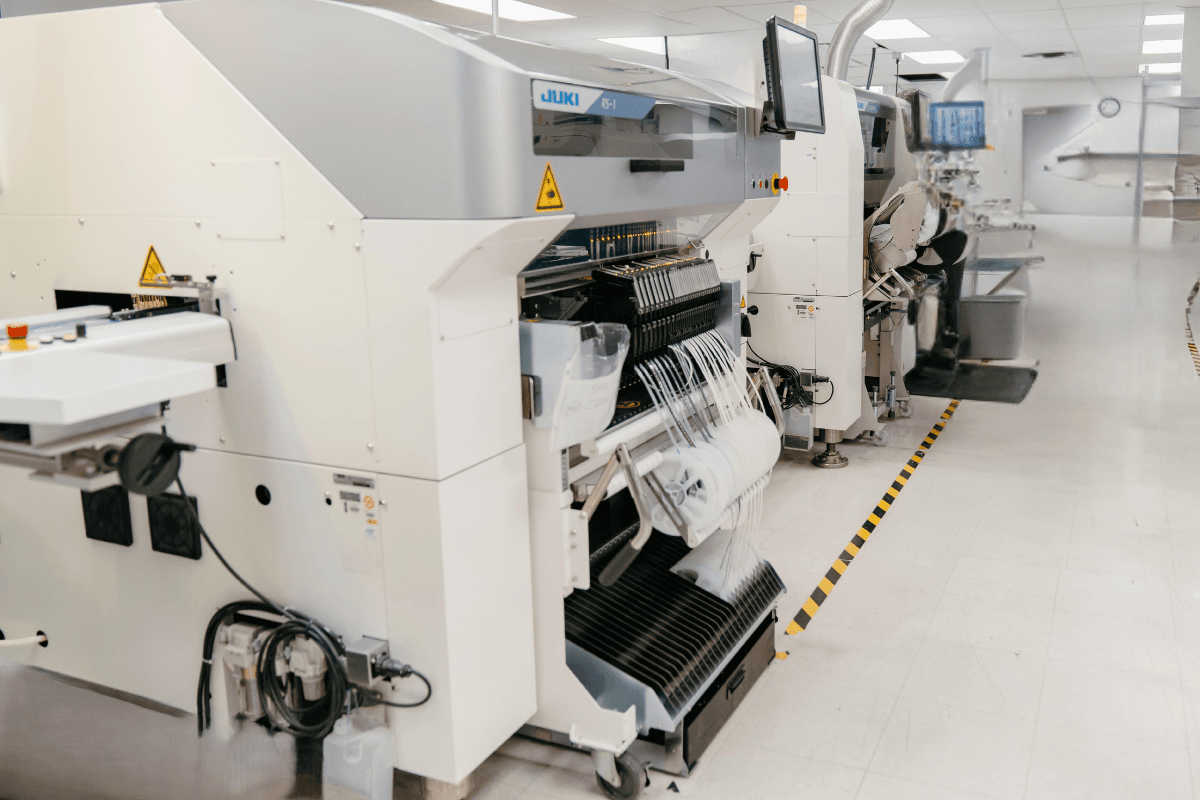
Every time a line stops to switch reels, reprogram SMT equipment, and recalibrate inspection for a different product, that’s downtime. Do that dozens of times a month across many small runs, and it adds up fast if the process isn’t built for it.
Complex supply chains multiply risk.
A single HMLV program can involve dozens or even hundreds of unique components. That raises per-unit costs and increases exposure to obsolescence and scheduling complexity, especially for components without a deep pool of alternates.
Quality and traceability get harder with variety.
Maintaining consistent quality across many product variants, each with its own bill of materials and test requirements, takes more disciplined process control than running one product at scale.
Many OEMs also run into internal capability gaps when scaling HMLV programs.
Not every organization has the in-house bandwidth for new product introduction (NPI), process engineering, and test development that HMLV production demands, particularly if they’re used to working with a manufacturer built for long, high-volume runs.
Why Flexibility Is the Differentiator in 2026
“Flexibility” gets used loosely in manufacturing marketing, so it’s worth being specific about what it means in practice. At IMS Electronics, we think about it in four parts.
1. Process Flexibility
This is the ability to change over SMT lines and test cells quickly and to run many different SKUs without forcing large batch sizes or long minimum runs just to make the economics work.
2. Supply-Chain Flexibility
This means building multi-sourcing strategies and alternate-component qualification into new product introduction from the start and being genuinely willing to manage low-volume, high-complexity BOMs rather than steering customers toward simpler, higher-volume programs.
3. Engineering Flexibility
Early collaboration on design for manufacturability (DFM) and design for testability (DFT) makes a real difference here. When engineering gets involved early, designs adapt to what’s actually buildable and testable in an HMLV environment, and the program can absorb iterative changes without derailing the schedule. We’ve written more on why this matters in our article on how DFM reduces manufacturing costs, if you want to go deeper.
4. Geographic Flexibility
For Canadian OEMs, being close enough to your manufacturing partner’s engineering team for a fast feedback loop, a same-week design tweak, or a quick walkthrough of the shop floor changes how a program runs. It also means being able to serve both Canadian and U.S. markets under CUSMA while managing tariff and compliance risk as those rules evolve.
What Canadian OEMs Should Look For In an HMLV Partner
If you’re evaluating manufacturing partners for a high-mix, low-volume program, a few things are worth confirming before you sign on.
- A track record in your sector. Complex programs come with their own quality and documentation expectations. A partner with direct experience in your sector will already understand them.
- NPI and DFM engagement that starts early. Look for a partner who wants to be involved during design, not just at the quoting stage.
- Documented changeover efficiency. Ask how they’ve reduced setup time and whether their SMT lines and test cells are built to handle multiple products, not just one at scale.
- Real supply-chain muscle. Strong distributor relationships, an alternate-parts program, and direct experience managing long-lead components all matter more in HMLV than in high-volume work.
- Relevant certifications and traceability systems. Confirm they hold the certifications your program requires and can show you how traceability works in practice, not just on paper.
- Geographic fit. Consider whether they can support your time zone, meet on-site when needed, and move product through North American logistics without added friction.
If your program has a short lifecycle, frequent design changes, and customization needs, a high-mix, low-volume manufacturing partner close to home is often a better fit than chasing the lowest per-unit cost on a rigid, high-volume line built for a different kind of product.
Flexibility as a Strategy, Not Just Production Mode
High-mix, low-volume manufacturing is becoming the default way many high-value electronics programs get built in North America, not just a niche approach reserved for prototypes. If your current production model is starting to feel rigid against how fast your requirements change, we encourage you to reach out to our team. Call IMS today to talk through how flexibility could de-risk your next program, or reach out through our contact form if you’d rather start there.